
What is an INO?
INO stands for Initial NFT Offering, a sales method used when an NFT project holds the first primary sale of its NFTs (Non-Fungible Tokens). It works much like an initial public offering (IPO) of shares: the NFT project's overview, roadmap and other details are published, and a set purchase reservation period is held. Among those who apply to buy during the sales period, the winners of a lottery can actually make the purchase.
By concentrating awareness of the project among many people within a set period, the project's appeal can be communicated widely and intensively in a short time. Buyers who take part in an INO also get the opportunity to buy a certain quantity in the very first primary sale.
Also, unlike ERC721, a single NFT can have multiple owners. This makes it possible to use NFTs not only for art projects but for all kinds of projects.

Advantages and disadvantages of an INO
Advantages of an INO
Holding an INO is an opportunity to make your NFT project widely known to many people in a short period. An INO also lets you sell to, and have your NFTs owned by, many people at once. As a result, many people can become stakeholders in the project through NFTs all at once, and it can also lead to fundraising opportunities.
Disadvantages of an INO
Because an INO sells many NFTs at once, the total sales amount tends to be lower than when selling in smaller portions. In an INO, the number sold is limited relative to purchase demand, so total sales may be lower than with normal sale methods. However, any price rises on the secondary market after the sale become income in the form of royalties, which softens this disadvantage.
Use an INO to increase stakeholders and lead your project to success
By holding an INO, NFT holders become stakeholders in the project. The project's success therefore leads to higher NFT value, which in turn rewards NFT holders. At HEXA, we hope that INOs will enable a variety of Web3-style projects to launch and become a new economic system.

About INOs on HEXA
INOs that can be held on HEXA use ERC1155-standard NFTs. Because they follow the ERC1155 standard, if, for example, an NFT project issues 100 units, those 100 units have no serial numbers and are all identical. Holdings are therefore expressed as quantities, such as holding 10 out of 100 or 1 out of 100, and all 100 issued units are identical.
ERC1155-standard NFTs sold on HEXA currently cannot be withdrawn. This is in line with current laws and guidelines, and withdrawal may become possible in the future. Also, because they cannot be withdrawn from HEXA, the minimum trading price for each NFT is ¥1,000 when paying in Japanese yen.
NFTs that can be issued must be non-crypto-asset NFTs that are not used as a means of payment, and must not qualify as securities, prepaid payment instruments or the like.
HEXA's review of INOs
HEXA applies stricter review criteria to NFT sales by INO than to its normal review. To apply for an INO, you must submit INO application documents. Please understand that submitting all the application documents does not guarantee that you will pass the review. In the review, we mainly check the following points.
Purpose of the NFT project
We check the purpose of the NFT project and judge, according to our own criteria, whether the NFT project is suitable for an INO.
Planned schedule (roadmap) of the NFT project
We check the NFT project's future plans and roadmap, including whether the plans and roadmap published at the time of the IEO reflect reality.
Operating structure of the NFT project
We check whether the operating structure is in place, whether the operating team is complete, whether the project will continue to be run, and so on. We also check the past track records of the operating team members, and we verify your identity.
Benefits of taking part in the NFT project
We check your plans, such as what benefits buyers will gain by taking part in the project over the medium to long term. The issuer must, of course, confirm the benefits themselves and also confirm that the NFTs do not qualify as securities or as crypto-assets or prepaid payment instruments under the Payment Services Act, and for the IEO the issuer will also be asked to provide representations and warranties.
Note that HEXA's review does not verify and guarantee all facts. Issuers make representations and warranties as to the truth of their information under the Terms of Use, but HEXA does not guarantee or review its credibility, so buyers should verify its accuracy at their own responsibility. If any statement is false, the issuer will bear legal liability.
What is a DAO?
DAO stands for Decentralized Autonomous Organization. It refers to an organization that does not depend on one or a few individuals or companies (a centralized authority) and is run on a blockchain authorized by an unspecified number of nodes, with decisions made by an unspecified number of people independently of the will of any centralized authority.
What is a quasi-DAO?
A pure DAO is impossible to achieve under the laws not only of Japan but of the world
Unfortunately, a theoretically perfect, ideal DAO is extremely difficult to achieve legally under the regulations of countries around the world, including Japan. For example, if a DAO itself violates the law, the individual who owns the largest share in the DAO may be held responsible, or the company operating the web server that provides the DAO's mechanism may be held responsible; it is usually judged that there is a de facto controller. This makes it difficult to be fully autonomous and decentralized. In Japan in particular, the individual who launched a DAO project may bear unlimited liability and face greater risk than with a limited-liability stock company. Furthermore, if DAO shares are held as tokens and those tokens are given decision-making rights or profit-distribution rights, they qualify as securities not only in Japan but also overseas and become subject to regulation by the authorities, and the individuals or companies that issued, sold or circulated the tokens may be charged with violating securities laws.
Forming a community within the law through a quasi-DAO
On the other hand, it is possible to run a community that incorporates the good aspects of a DAO within the bounds of the law. In a DAO, the various individuals and companies belonging to it have a Web3-style relationship (holding ownership of part of the project with data as an asset) and act autonomously and in a decentralized way to develop the project and increase its value, creating a relationship in which the value of the project's tokens, such as NFTs, rises as a result.
As long as profits are not distributed to users who hold the tokens themselves and organizational decisions are not determined by the shares of token-holding users, it can be run without qualifying as securities.
For example, cases are envisaged (in substance) in which demand for the project's tokens, such as NFTs, rises indirectly as the project itself becomes popular and succeeds, or in which votes are held according to token holdings but the final decision rests solely with the issuer driving the project, who is under no obligation to follow the result.
By forming DAO-like, quasi-DAO relationships purely through loose ties within a community, without legal or technical binding force, you can incorporate the good aspects of the DAO concept.
DAO management tools on HEXA
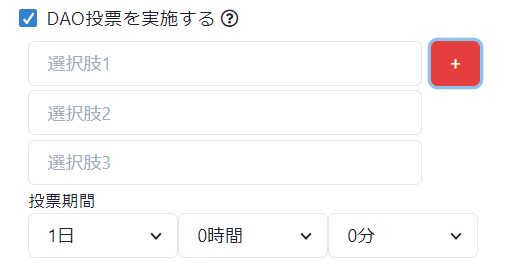
You can run a DAO by using the holder-only community feature. The community feature includes a DAO voting function. Using the DAO voting function, votes can be held according to the number of NFTs held, allowing issuers and project operators to gauge the wishes of NFT holders.
Examples of INO sales on HEXA

The “Nishikawa Town, Yamagata Prefecture digital resident NFT,” which drew attention as Japan's first municipal digital resident NFT, saw a rush of purchase reservations on the NFT marketplace HEXA: orders exceeded the 1,000 units for sale in just 1 minute, and in the end it drew purchase demand for 13,440 units, 13.4 times the number for sale.
By using the HEXA NFT marketplace, municipalities can issue NFTs without holding a crypto-asset wallet or crypto-assets. This has made it possible for Japanese municipalities to officially issue NFTs under the Local Finance Act, laying the groundwork for municipalities to readily take on Web3 initiatives using NFTs.
The digital resident NFT of Nishikawa Town, Yamagata Prefecture, is an unprecedented first case in Japan. We believe this success will serve as a precedent and spark new regional revitalization initiatives using NFTs across Japan. Creating related population — people who maintain an ongoing connection to a region without living there — through NFTs is also in line with “developing an environment to promote Web3, including the use of NFTs (non-fungible tokens) based on blockchain technology,” as stated in the Basic Policy on Economic and Fiscal Management and Reform (the “Honebuto Policy”) announced by the Kishida Cabinet in 2022. HEXA, one of Japan's largest NFT marketplaces, will continue to work with Nishikawa Town, Yamagata Prefecture, with which it has concluded a comprehensive partnership agreement, on “expanding the use of content, including the metaverse,” also stated in the Honebuto Policy, through the use of HEXA Metaverse and more.

Examples of NFT sales on HEXA

In the HEXA LAND NFT (ad-space NFT) sale held from 22:00 on April 12 (Tue), 2022 to 21:59 on April 13 (Wed), 2022, even though buyers were limited to holders of HEXA's Residents NFT, demand reached ¥148,032,000 against ¥18,360,000 worth for sale.
<Demand>
Reserved amount: ¥148,032,000
Number of reservations: 2,049
Number of reservers: 772
<Sales>
Sales amount: ¥18,360,000
Number of sales: 721
Number of buyers: 489
<Ratio>
Amount: 8.06x
Count: 2.84x
People: 1.57x