
What is an NFT?
In a world without NFTs, it was difficult to find asset value in digital works, because anyone could easily make an unlimited number of copies identical to the original. The arrival of blockchain technology in recent years changed that. By issuing an NFT, it became possible to give a digital work the value of a "one-of-a-kind" item. NFTs have overturned conventional thinking about digital content, and they are now attracting a great deal of attention.
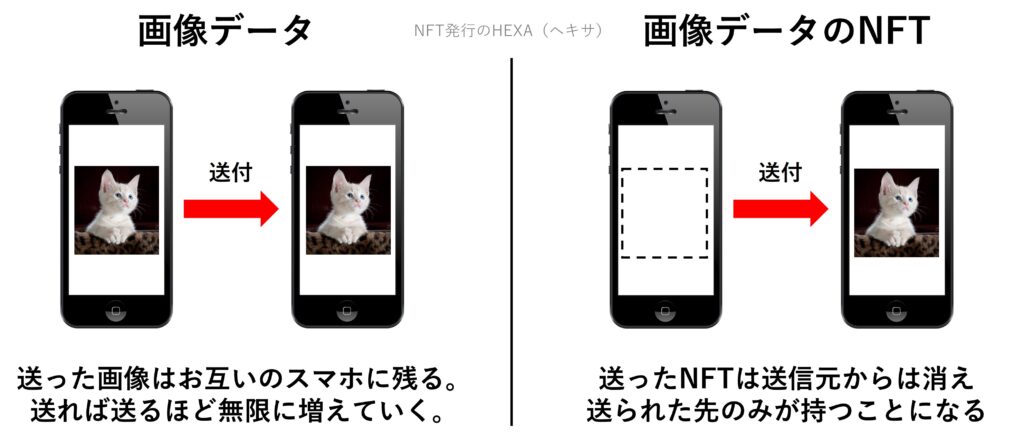
The above is a conceptual analogy to help understand NFTs. When you send image data by email, for example, the data is duplicated and a copy remains with both the sender and the recipient. In a world without NFTs, data was copied endlessly. With an NFT, however, when you send the NFT to someone, it disappears from the sender. The data itself does not vanish; rather, ownership of the NFT is transferred to the recipient. This technology has made it possible to do on the internet what we have always done with one-of-a-kind items in the real world.
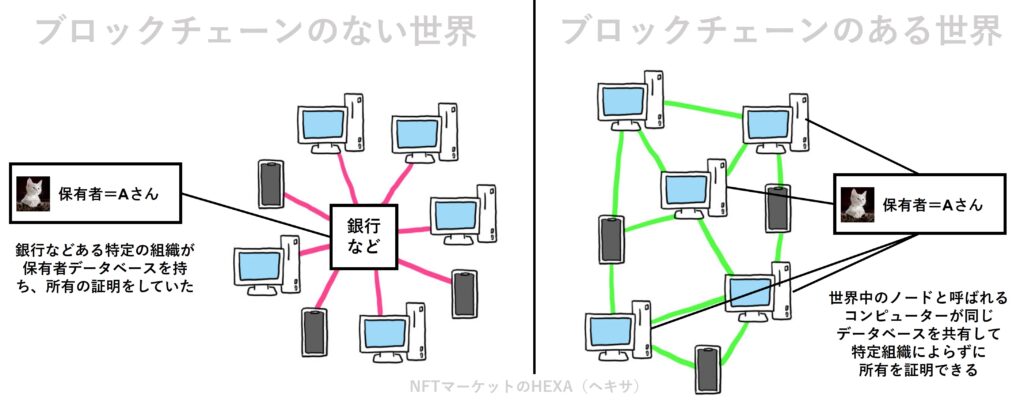
The diagram above also illustrates the technical concept of NFTs: blockchain technology is the mechanism used to give digital data an owner. Previously, proving ownership of digital data required a centralized institution such as a bank. Before blockchain, that institution kept a ledger recording who held which data, and that is how ownership was established. With the arrival of blockchain technology, however, computers around the world called nodes all hold the same database (a distributed ledger) without relying on any such centralized organization, which makes it possible to identify a single owner of the data.
What is an NFT marketplace?
An NFT marketplace is a service that lets you turn digital data into NFTs (digital assets) and sell them, and also lets you buy, hold and even resell them. NFT marketplaces range from the world's largest, OpenSea (which requires crypto and a wallet), to HEXA, one of Japan's largest, which requires neither crypto nor a wallet. In this article, we introduce these NFT marketplaces by category.
Comparing NFT marketplaces by category (C2C or B2C, yen or crypto)
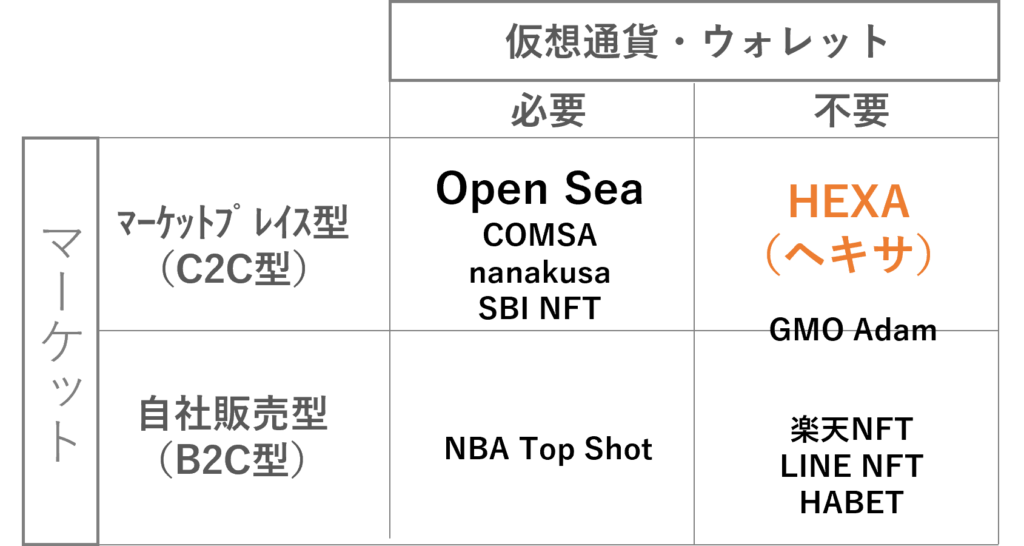
One way to categorize NFT marketplaces is along two axes: whether they are C2C or B2C, and whether payment is in yen or in crypto. Categorized along these axes, they look like this.
C2C (marketplace) or B2C (direct sales)
The first axis is whether a service is a marketplace (C2C) or a direct-sales platform (B2C). On a marketplace, anyone can freely carry out a primary sale of NFTs (turning digital data they created into an NFT and selling it).
On OpenSea, one of the world's largest, anyone with a wallet and gas fees (in crypto) can issue and sell NFTs as a primary sale. On HEXA, one of Japan's largest, anyone with an X (formerly Twitter) account can issue and sell NFTs as a primary sale at no cost.
COMSA on Symbol (XYM) also allows purchases paid in Japanese yen, but it requires a Symbol wallet; it is a marketplace where anyone can issue NFTs. nanakusa and SBI NFT are also marketplaces with the same functions as OpenSea, where anyone with a wallet and crypto can issue NFTs.
On the other hand, NBA Top Shot overseas lets you buy NFTs of content provided by the platform, but members of the public cannot issue their own. Rakuten NFT and LINE NFT are likewise direct-sales (B2C) marketplaces where the platform sells well-known content. Even on direct-sales platforms, however, you can resell the NFTs you buy on the secondary market. GMO Adam does not let just anyone issue NFTs, but issuers can apply in advance and issue NFTs after passing a review, so we have placed it on the borderline.
Whether crypto or a wallet is required
The next axis is whether a marketplace requires crypto such as ETH, MATIC or XYM, or a wallet such as MetaMask or a Symbol XYM wallet, to issue or buy NFTs. It is commonly said that only about 10,000 Japanese users hold NFTs in a wallet on OpenSea. Because you have to open an account with a crypto-asset exchange, buy crypto-assets, send them to MetaMask or a Symbol wallet, and then connect to the site from there, the barrier is still considered high for most ordinary users.
As a result, even when companies that own IP content or influencers with fans wanted to issue NFTs to build connections with their fans, most of those fans had no crypto or wallet, which made issuing NFTs difficult. HEXA, along with Rakuten NFT and LINE NFT, accepts credit card payments in Japanese yen and requires no wallet, so many influencers and companies have started issuing NFTs, and connections are beginning to form through NFTs with users who have no crypto or wallet.
Comparing NFT marketplaces by category 2 (blockchain and withdrawal)
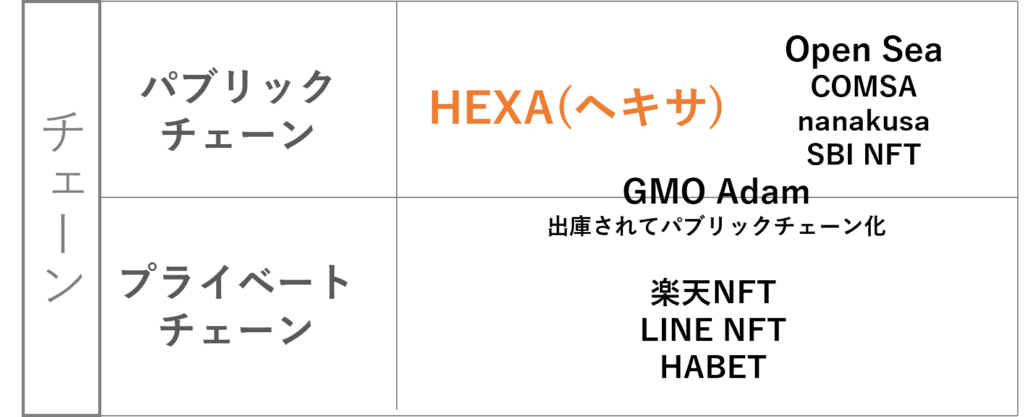
Another way to categorize NFT marketplaces is by whether they use a public or private blockchain, and by how difficult it is to withdraw NFTs. Categorized along these axes, they look like this.
Public blockchain or private blockchain
The next axis is the type of blockchain on which the NFTs are issued. On a public blockchain (Ethereum, Polygon or Symbol), the NFTs themselves remain as long as the blockchain exists, even if the NFT marketplace shuts down. On a private blockchain, by contrast, the NFTs themselves disappear when the marketplace shuts down (although some services let you withdraw them to a public blockchain when they close).
Each type of blockchain has its advantages and disadvantages. NFTs gain value when everyone recognizes value in the digital data, so even on a private blockchain, an NFT can become valuable if people recognize its value. A private blockchain has the advantage of stronger governance (the operator can freely manage it afterward, so it can respond if a security problem occurs). Unlike a private blockchain, a public blockchain has the disadvantage that once an NFT is withdrawn, the service can no longer manage it, but some see that very fact as part of an NFT's value, so we recommend choosing after understanding the characteristics of each.
OpenSea, one of the world's largest, supports the Ethereum, Polygon and Solana blockchains, and HEXA, one of Japan's largest, is a public-blockchain NFT marketplace supporting Ethereum and Polygon. With GMO Adam, an NFT is written to a public blockchain only once it is withdrawn (until then it is on a private blockchain), which requires the buyer to pay a withdrawal fee of 0.05 ETH (a fee of ¥15,000, assuming 1 ETH = ¥300,000). We have therefore placed it midway between private and public blockchains. The NFT is written to the private blockchain only once the buyer pays the 0.05 ETH fee. Rakuten NFT, LINE NFT and HABET all issue NFTs on their own private blockchains.
How difficult it is to withdraw NFTs
Because HEXA does not require a wallet, when a user buys an NFT, the NFT has already been issued on a public blockchain but is held in custody in HEXA's wallet. Users can withdraw these NFTs to their own wallet at any time free of charge. If you send an NFT out and then deposit it back into HEXA, gas fees for the transfer are charged in crypto. OpenSea, nanakusa and SBI NFT work the same way as OpenSea: you cannot trade without a wallet and currency, and trades are made from each user's own wallet. As mentioned above, GMO Adam charges a fee of 0.05 ETH, roughly ¥15,000, when you withdraw an NFT.
Other technical points of comparison (governance and on-chain storage)
There are many other points of comparison, such as comparisons between blockchains and how the original data behind an NFT is stored. These are somewhat technical, so please also see this article ( Proof-of-ownership or fully on-chain: which is better? ).
Examples of NFTs issued on Japanese NFT marketplaces
Tsubasa Yozawa's tweet NFT (¥10.41 million)
A tweet NFT of entrepreneur Tsubasa Yozawa's post announcing the birth of his second child was sold at auction, with a winning bid of about ¥10.41 million.
Mr. Yozawa's tweet NFT was issued as the first project of HEXA, a Japanese service that turns posts into NFTs.
The auction had a minimum winning bid of 0.03 ETH (about ¥7,730) and ran for a limited 5 days (120 hours), from 2021/06/15 (Tue) to 06/19 (Sat). Just about 2 hours after it opened, the price reached about ¥2 million (7.1 ETH), and on the second day it rose sharply to about ¥6.47 million (24 ETH). Toward the final day, many new bidders placed bids, and in the end Idainaru Bana-oji won the auction for about ¥10.41 million (42 ETH).
In this auction, the entire winning bid minus fees was distributed as a giveaway campaign to 7 followers carefully selected by Mr. Yozawa.
On HEXA, anyone can issue and sell a tweet NFT in just 30 seconds, and many influencers have started selling them.

| NFT issuer | Tsubasa Yozawa |
| Issuing service | HEXA [Japan] |
| Blockchain | Ethereum |
| Accepted currency | ETH or yen |
| Number issued | 1 |
| Sale price | 42 ETH (about ¥10,413,960) |
| Reference URL | URL |

HEXA LAND Genesis NFT ad-space NFT (¥6 million)
HEXA LAND NFTs are ad-space NFTs that will allow holders to place ads on the HEXA platform in the future. NFT holders not only own a slot for placing ads in the future but can also benefit from the growth of the HEXA service. It is a Web3 initiative aiming for a world where the whole community grows the HEXA service together and the whole community shares in the rewards.

| NFT issuer | HEXA |
| Issuing service | HEXA [Japan] |
| Blockchain | Polygon |
| Accepted currency | Yen |
| Number issued | 1 |
| Sale price | ¥6,000,000 |
| Reference URL | URL |
Park naming rights NFT of Nishikawa Town, Yamagata Prefecture (¥1.3 million)
Many municipalities sell naming rights to parks, pedestrian bridges and streets, but naming rights in lesser-known or sparsely populated areas often receive no bids at all. Against this backdrop, the naming rights to a park in a town of about 5,000 people, offered as an NFT, drew 47 bids and sold for ¥1.3 million. The naming rights NFT drew in many individuals and companies and sparked a lot of excitement.

| NFT issuer | Nishikawa Town, Yamagata Prefecture |
| Issuing service | HEXA [Japan] |
| Blockchain | Polygon |
| Accepted currency | Yen |
| Number issued | 1 |
| Sale price | ¥1.3 million |
| Reference URL | URL |

Masato Morishige's tweet NFT (¥220,000)
To try a new way of interacting with supporters, professional soccer player Masato Morishige turned his post about his resolutions for 2022 into an NFT. The NFT was sold by auction on HEXA starting at 11:11 on January 11, 2022. It includes holder-only content that only the holder can view: videos of his goals for the team, his personal goals, a New Year's greeting and a thank-you to the winning bidder. Morishige also announced that he would donate all the proceeds from the sale.
Because this auction required no crypto or wallet and accepted credit card payments in Japanese yen, it was won by an individual, FC Tokyo supporter Pojiko. She was also the person who placed the very first bid, of ¥1,111. During the auction, Masato Morishige replied directly to supporters, creating an atmosphere as lively as a live event.

| NFT issuer | Masato Morishige |
| Issuing service | HEXA [Japan] |
| Blockchain | Polygon |
| Accepted currency | Yen |
| Number issued | 1 |
| Sale price | ¥220,111 |
| Reference URL | URL |
Art NFT (¥300,000)

| NFT issuer | Sync Kudo – Sync.Kudo |
| Issuing service | HEXA [Japan] |
| Blockchain | Polygon |
| Accepted currency | Yen |
| Number issued | 1 |
| Sale price | ¥300,000 |
| Reference URL | URL |
Support NFT of House of Representatives member Yasushi Adachi (¥140,000)

| NFT issuer | Yasushi Adachi |
| Issuing service | HEXA [Japan] |
| Blockchain | Polygon |
| Accepted currency | Yen |
| Number issued | 1 |
| Sale price | ¥140,000 |
| Reference URL | https://nft.hexanft.com/nft/issue/aYLe1M7A |
NFT of Yuichiro Tamaki, leader of the Democratic Party for the People (¥100,000)

| NFT issuer | Yuichiro Tamaki |
| Issuing service | HEXA [Japan] |
| Blockchain | Polygon |
| Accepted currency | Yen |
| Number issued | 1 |
| Sale price | ¥100,000 |
| Reference URL | https://nft.hexanft.com/nft/issue/LR9knExA |
Team card NFT by artist nanao (¥131,000)

| NFT issuer | Nanao |
| Issuing service | HEXA [Japan] |
| Blockchain | Polygon |
| Accepted currency | Yen |
| Number issued | 1 |
| Sale price | ¥131,000 |
| Reference URL | https://nft.hexanft.com/nftmatic/14116 |
Music NFT by artist Reina Takeda (¥77,000)

| NFT issuer | NFT MUSIC FM |
| Issuing service | HEXA [Japan] |
| Blockchain | Polygon |
| Accepted currency | Yen |
| Number issued | 1 |
| Sale price | ¥77,000 |
| Reference URL | https://nft.hexanft.com/nftmatic/29367 |
Illustration NFT (¥100,000)

| NFT issuer | Kazu ⧉ manga "Zoo-man" |
| Issuing service | HEXA [Japan] |
| Blockchain | Ethereum |
| Accepted currency | Yen |
| Number issued | 1 |
| Sale price | ¥100,000 |
| Reference URL | https://nft.hexanft.com/nft/10 |
Photo NFT of a gravure idol (¥100,000)

| NFT issuer | Yoshino Chitose |
| Issuing service | HEXA [Japan] |
| Blockchain | Polygon |
| Accepted currency | Yen |
| Number issued | 1 |
| Sale price | ¥100,000 |
| Reference URL | https://nft.hexanft.com/nftmatic/1889 |
Video NFT (¥130,000)

| NFT issuer | Eri Momoeda |
| Issuing service | HEXA [Japan] |
| Blockchain | Polygon |
| Accepted currency | Yen |
| Number issued | 1 |
| Sale price | ¥130,000 |
| Reference URL | https://nft.hexanft.com/nft/issue/QYbNZeY0 |
Illustration NFT by manga artist Kamui Fujiwara (¥100,000)

| NFT issuer | Kamui Fujiwara |
| Issuing service | HEXA [Japan] |
| Blockchain | Polygon |
| Accepted currency | Yen |
| Number issued | 1 |
| Sale price | ¥100,000 |
| Reference URL | https://nft.hexanft.com/nftmatic/37717 |
Comedy sketch video NFT by comedians Yodaredori (¥32,000)

| NFT issuer | Sun Music GET |
| Issuing service | HEXA [Japan] |
| Blockchain | Polygon |
| Accepted currency | Yen |
| Number issued | 1 |
| Sale price | ¥32,000 |
| Reference URL | https://nft.hexanft.com/nftmatic/25077 |
Fudanjuku drawing and message set (¥20,000)

| NFT issuer | Fudanjuku |
| Issuing service | HEXA [Japan] |
| Blockchain | Polygon |
| Accepted currency | Yen |
| Number issued | Multiple |
| Sale price | ¥20,000, ¥10,000, ¥9,000, etc. |
| Reference URL | https://nft.hexanft.com/nftmatic/38540 |
Okinawa Electric Power transmission tower card NFT (¥10,000)

| NFT issuer | Okinawa Electric Power Company |
| Issuing service | HEXA [Japan] |
| Blockchain | Polygon |
| Accepted currency | Yen |
| Number issued | 50 |
| Sale price | ¥10,000 × 5, ¥4,000 × 10, ¥3,000 × 15, ¥2,000 × 20 |
| Reference URL | https://nft.hexanft.com/nftmatic/38935 |