
HEXA, one of Japan's largest NFT marketplaces, attached NFT certification to limited-edition asset goshuin issued by Torikai Hachimangu Shrine, a first in Japan, and sold them at 20 times the usual price.
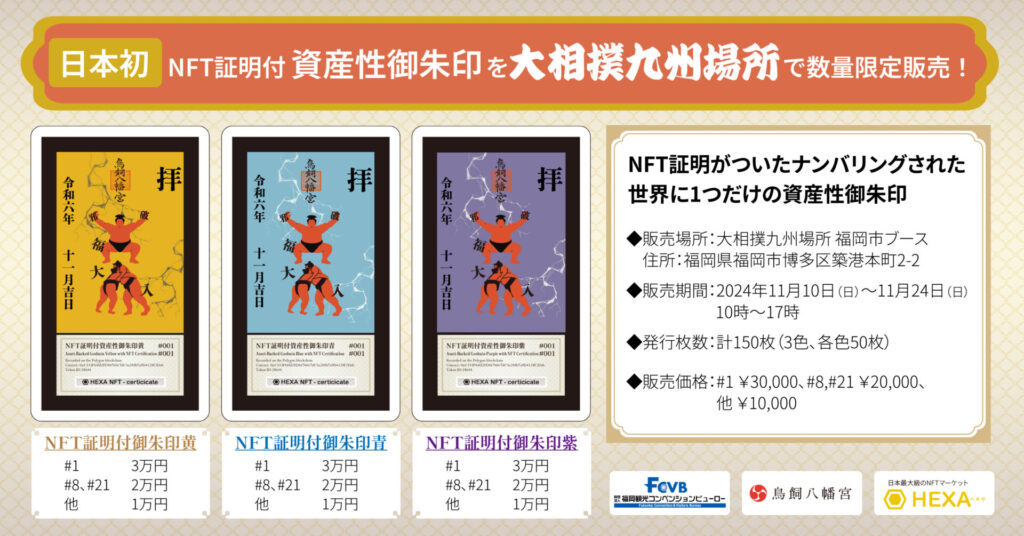
As part of the Japan Tourism Agency's "Project to Expand and Enhance Inbound Consumption through Special Experiences," undertaken by the Fukuoka Convention & Visitors Bureau (a public interest incorporated foundation), HEXA, one of Japan's largest NFT marketplaces, has realized Japan's first issuance of asset goshuin (shrine seal stamps): limited-edition goshuin issued by Torikai Hachimangu Shrine, each with NFT certification that guarantees its uniqueness.
Torikai Hachimangu Shrine issues the goshuin in 3 colors (50 of each), for a total of only 150. Each goshuin is numbered, and only 150 exist in the world. On their own, goshuin risk being copied or forged, but every one of the 150 carries NFT certification using blockchain technology, which prevents copying and forgery. Even if a goshuin itself is copied or forged, the NFT that serves as its certificate cannot be copied or duplicated, so transferring or trading the goshuin together with its certificate NFT makes it possible to prevent forgery.
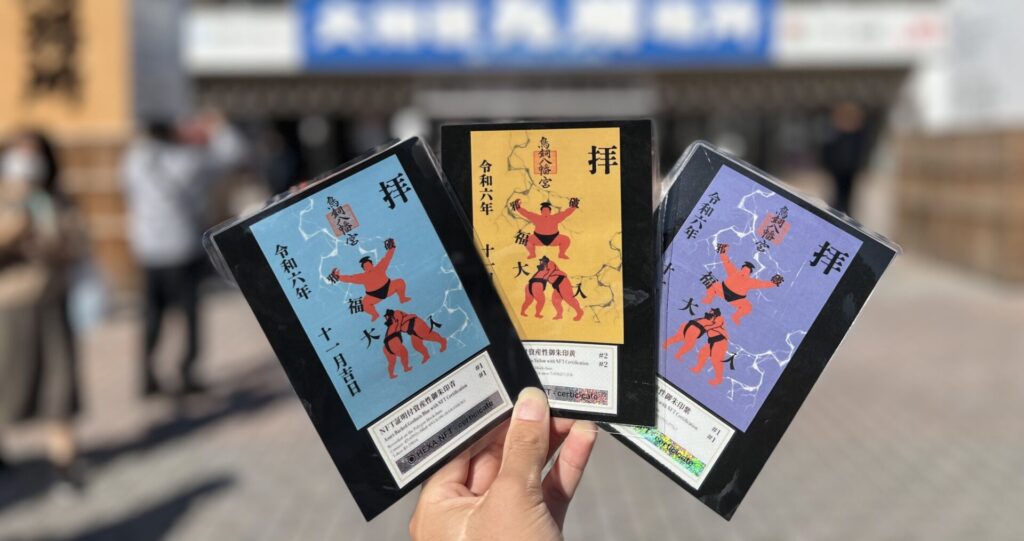
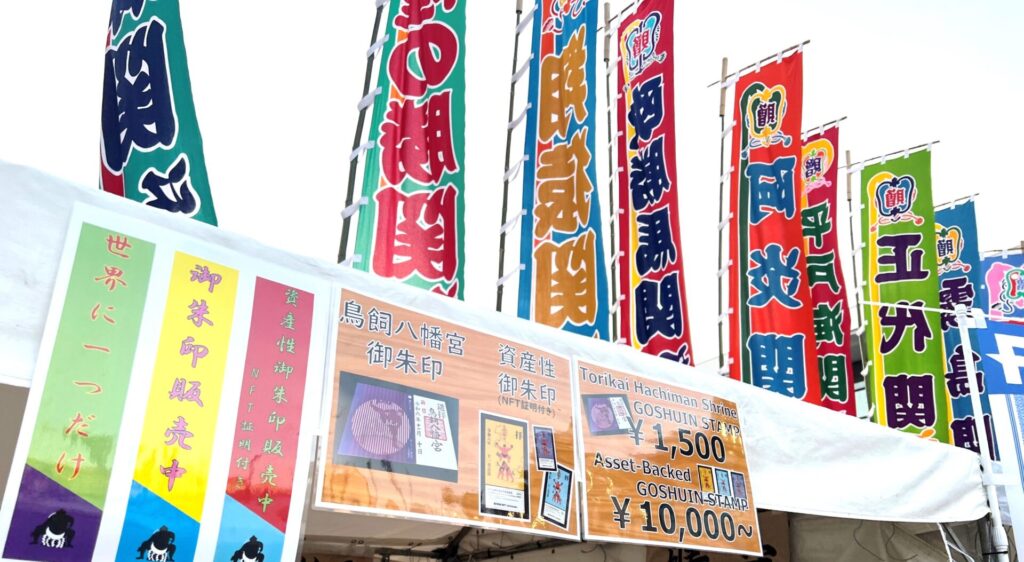
This gives asset value to goshuin, for which managing the number issued and proving authenticity had been difficult, and they are sold mainly to inbound foreign tourists visiting Japan for the Kyushu Grand Sumo Tournament. A regular goshuin sells for ¥1,500, while the limited-quantity asset-grade goshuin with NFT certification sell for ¥10,000–¥30,000, up to 20 times the price.
This is an NFT initiative based on the policy of "Regional Revitalization 2.0," put forward by Japan's prime minister to protect regional areas, which calls for "using blockchain technology and NFTs to re-price the diverse analog value of regions, such as food and tourism experiences, at global prices and maximize it." Taking advantage of the NFT's ability to prove uniqueness, it re-prices the economic value of goshuin at global prices in a way that prevents copies and counterfeits from circulating.
About the sale of asset goshuin with NFT certification
◇Quantity
Goshuin with NFT certification, Yellow #1–50 (50 in total)
Goshuin with NFT certification, Blue #1–50 (50 in total)
Goshuin with NFT certification, Purple #1–50 (50 in total)
150 in total
◇Price
Goshuin with NFT certification, Yellow: #1 (¥30,000), #8 and #21 (¥20,000), others (¥10,000)
Goshuin with NFT certification, Blue: #1 (¥30,000), #8 and #21 (¥20,000), others (¥10,000)
Goshuin with NFT certification, Purple: #1 (¥30,000), #8 and #21 (¥20,000), others (¥10,000)
◇Place of sale
Fukuoka City booth at the Grand Sumo Kyushu Tournament
Address: 2-2 Chikkohonmachi, Hakata-ku, Fukuoka City, Fukuoka Prefecture
◇Sales period
November 10 (Sun) – November 24 (Sun), 2024, 10:00–17:00
◇Payment methods
Cash, credit card
*Japanese residents can also purchase. Each person may buy more than one.
About the NFT certification
Goshuin issued by: Torikai Hachimangu Shrine
NFT certification issued by: Tobu Top Tours Co., Ltd.
NFT issued and managed by: HEXA, an NFT marketplace
The thinking behind the design of Torikai Hachimangu Shrine's asset goshuin
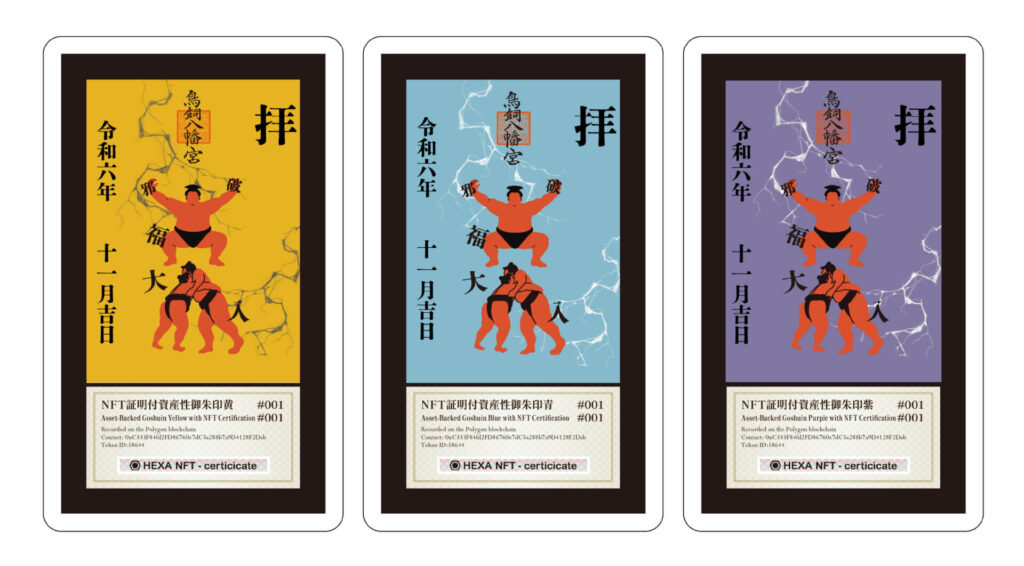
Torikai Hachimangu Shrine designed the goshuin to convey the image of sumo as a Shinto ritual. Sumo, which originates in Japanese mythology, has carried on its character as a sacred rite. The dohyo (ring) is a holy place that has been purified, and the chosen wrestlers are living vessels for the divine who clash while clad in sacred energy. Stomping (shiko) calms the evil spirits of the earth, and clapping (kashiwade) purifies the air.
Sumo tournaments were not only great entertainment but also solemn festivals, just like shrine festivals. Hachimangu shrines are worshipped as home to the god of victory, and this shrine offers an amulet called "Kachimamori" (victory charm). Based on the Kachimamori design, the goshuin features wrestlers clapping and wrestlers clashing, and carries the motto "Haja Shofuku" (ward off evil, invite good fortune) along with the wish that the happiness of watching grand sumo will last forever. Because it uses the amulet's design, it also carries the same divine virtues and blessings as the Kachimamori.
Asset goshuin with NFT certification sold at 20 times the price of a regular goshuin
Asset goshuin with NFT certification went on sale on November 10 (Sun), 2024, mainly for inbound visitors, and the most expensive one, Yellow #1, has already sold for ¥30,000.
Goshuin (usually sold for ¥1,500) have traditionally made it difficult to control the number issued or to prove authenticity. By attaching NFT certification and numbering them to give them asset value, and selling them mainly to foreign tourists visiting Japan for the Grand Sumo Kyushu Tournament, we were able to re-price them at global prices and sell them at 20 times the usual price.
This result is a success story for an NFT initiative based on the policy of "Regional Revitalization 2.0," put forward by Prime Minister Ishiba to protect regional areas, which calls for "using blockchain technology and NFTs to re-price the diverse analog value of regions, such as food and tourism experiences, at global prices and maximize it." Taking advantage of the NFT's ability to prove uniqueness, it re-priced the economic value of goshuin at global prices in a way that prevents copies and counterfeits from circulating.
About Torikai Hachimangu Shrine
Torikai Hachimangu Shrine is a Shinto shrine in Fukuoka City, Fukuoka Prefecture, that enshrines Hachiman (Emperor Ojin), a deity known throughout Japan. Its principal deities are Emperor Ojin, Empress Jingu and Tamayorihime no Mikoto, and it is believed to bring blessings such as matchmaking, protection from misfortune and recovery from illness, drawing worshippers from among local residents and tourists alike. Historically, it is said to have been founded about 1,800 years ago; located in Imagawa, Chuo-ku, Fukuoka City, it has long been revered as the local guardian shrine. Old trees line its grounds, giving it a tranquil atmosphere.
About HEXA, the NFT marketplace
A Japanese NFT marketplace where you can issue, buy and sell NFTs using Japanese yen alone. You can easily buy NFTs by credit card from a PC or smartphone. No crypto or wallet is needed at all, so you can buy, sell or issue NFTs right away. If you have a HEXA Residents NFT or a LAND NFT, you can also display the NFTs you buy in the HEXA Metaverse. HEXA also offers community features such as Web3-style online salons and fan clubs.
How NFT issuance works: https://hexanft.com/issuermanual/
Apply to issue NFTs here: https://nft.hexanft.com/issue