
- This page covers 21 municipalities and 21 case studies.
- Nishikawa Town, Yamagata Prefecture, attracted about 1,915 visitors from outside the town with its digital resident NFT (as of the end of September 2024).
- Yachiyo Town, Ibaraki Prefecture, created a related population (people who maintain an ongoing connection to a region without living there) of 788 people at under ¥1,000 per person (typical costs of attracting visitors from outside a town are around ¥2,000–¥20,000).
- Naming rights to a park were won at auction for ¥1.3 million, and naming rights to a new canoe center for ¥1.5 million. NFTs for talks by the town mayor sold out at ¥3 million worth.
- NFT initiatives can be carried out even without a budget. If nothing sells, no costs are incurred.
Contents
- Overview of how municipalities use NFTs for regional revitalization
- Municipal success stories with membership & ticket NFTs
- Success in increasing visitors from outside the town [Nishikawa Town, Yamagata Prefecture]
- Success in attracting visitors from far away [Mine City, Yamaguchi Prefecture]
- Low-cost visitor attraction using local specialties: the "Unlimited Fruit Ticket" [Yachiyo Town, Ibaraki Prefecture]
- Supporting local industry and securing revenue with NFTs for talks by the well-known town mayor and beer ticket NFTs for a local specialty
- New-crop rice ticket NFTs to promote local specialties and attract visitors [Tadami Town, Fukushima Prefecture]
- Membership NFT in partnership with local yakiniku restaurants and other shops [Habikino City, Osaka Prefecture]
- Ambassador NFTs by cosplayers × 7 local governments [Nachikatsuura Town, Wakayama Prefecture; Uda City, Nara Prefecture; Joyo City, Kyoto Prefecture; Kamigori Town, Hyogo Prefecture; Mashiko Town, Tochigi Prefecture; Otsuki City, Yamanashi Prefecture; Fujikawa Town, Yamanashi Prefecture]
- Cabinet Office Regional Revitalization 2.0 Model Project: expanding related population through NFT × DAO (Uda City, Nara Prefecture; Otsuki City, Yamanashi Prefecture; Nachikatsuura Town, Wakayama Prefecture)
- Turning fans nationwide into related population with paid project passes: artist IP × 5 municipalities [Yachiyo Town, Ibaraki Prefecture; Noda City, Chiba Prefecture; Katsuragi City, Nara Prefecture; Hakui City, Ishikawa Prefecture; Takahama Town, Fukui Prefecture]
- From free distribution to paid memberships: deepening ties with a highly engaged related population [Toyama City, Toyama Prefecture]
- Digital resident NFT in partnership with a manga artist's IP [Kumakogen Town, Ehime Prefecture]
- A digital membership card offering lasting discounts on roadside station (michi-no-eki) experiences [Ogawa Town, Saitama Prefecture]
- Digital resident NFT exhibited at the "Regional Revitalization SDGs Fes" at Expo 2025 Osaka, Kansai [Habikino City, Osaka Prefecture]
- Municipal success stories with free NFT distribution
- Flooded with applications from outside the prefecture! The TOYAMA Mirai Citizen Passport [Toyama City, Toyama Prefecture]
- Free trading card NFTs for social media campaign and in-person event participants [Nishikawa Town, Yamagata Prefecture]
- 5 municipalities in a Cabinet Office model project distribute regional NFTs free and take part in product development via a DAO [Yachiyo Town, Ibaraki Prefecture; Noda City, Chiba Prefecture; Katsuragi City, Nara Prefecture; Hakui City, Ishikawa Prefecture; Takahama Town, Fukui Prefecture]
- Municipal success stories with certificate NFTs
- Municipal success stories with naming rights NFTs
- Furusato nozei (hometown tax donation) NFTs & support NFTs
- NFT by Yuichiro Tamaki, leader of the Democratic Party for the People
- Municipal NFT × DAO case studies
- NFT initiatives as a low-cost way for municipalities to attract visitors
- Regional revitalization NFT issuance support for municipalities
The Japanese government has announced that it will promote initiatives using NFTs in the "Priority Policy Program for Realizing Digital Society," the "Basic Policy on Economic and Fiscal Management and Reform 2022 (Honebuto Policy)" and the "Grand Design and Action Plan for a New Form of Capitalism," all approved by the Cabinet on June 7, 2022, as well as in the "Headquarters for Creating New Regional Economies and Living Environments," a ministerial council on regional revitalization measures established on November 8, 2024.


Source: Shigeru Ishiba's policy platform
Against this backdrop, many examples of NFT use by local governments have already accumulated in Japan. We have therefore summarized the key points of each municipality's NFT initiatives by category in an easy-to-understand way.
Overview of how municipalities use NFTs for regional revitalization
Picking out the success stories among municipal use cases, they fall mainly into the 5 patterns below. NFTs are used for many purposes, including expanding related population, city promotion, supporting local industry, securing revenue and increasing furusato nozei donations.
| How NFTs are used | Purpose of using NFTs |
| Membership & ticket NFTs | Selling local products and services as a bundle |
| Free NFT distribution | Retaining related population digitally |
| NFT certificates | Adding value to local products and services |
| Naming rights NFTs | Selling naming rights that otherwise don't sell |
| Furusato nozei (hometown tax donation) NFTs & support NFTs | Selling NFTs to raise funds |
Another strength of NFT initiatives is that they can be carried out without a budget. Being able to run them at no cost, before drawing up next fiscal year's budget, also means initiatives can be implemented quickly.
With the challenges faced on the vertical axis and the initiatives on the horizontal axis, they can be organized as follows.

List of municipal NFT case studies
| Municipality | How used | Main results / scale | Details |
|---|---|---|---|
| Nishikawa Town, Yamagata Prefecture | Membership & ticket NFTs | About 1,915 visitors from outside the town (end of September 2024) | Article |
| Mine City, Yamaguchi Prefecture | Membership & ticket NFTs | Attracted visitors from far away; covered on TV | Article |
| Yachiyo Town, Ibaraki Prefecture | Membership & ticket NFTs | Created a related population of 788 people at under ¥1,000 per person | Article |
| Nishikawa Town, Yamagata Prefecture | Membership & ticket NFTs | NFTs for talks by the town mayor sold out at ¥3 million worth | — |
| Tadami Town, Fukushima Prefecture | Membership & ticket NFTs | Led to media exposure and visitors | Article |
| Habikino City, Osaka Prefecture | Membership & ticket NFTs | More partner shops offering perks after launch | Article |
| Nachikatsuura Town, Wakayama Prefecture; Uda City, Nara Prefecture; Joyo City, Kyoto Prefecture; Kamigori Town, Hyogo Prefecture; Mashiko Town, Tochigi Prefecture; Otsuki City, Yamanashi Prefecture; Fujikawa Town, Yamanashi Prefecture | Membership & ticket NFTs | Run jointly by 7 municipalities | Article |
| Uda City, Nara Prefecture; Otsuki City, Yamanashi Prefecture; Nachikatsuura Town, Wakayama Prefecture | Membership & ticket NFTs | NFT × DAO related population initiative across 3 municipalities | — |
| Yachiyo Town, Ibaraki Prefecture; Noda City, Chiba Prefecture; Katsuragi City, Nara Prefecture; Hakui City, Ishikawa Prefecture; Takahama Town, Fukui Prefecture | Membership & ticket NFTs | Paid passes with voting rights (holding more increases influence) | Article |
| Toyama City, Toyama Prefecture | Membership & ticket NFTs | ¥1,000, 500 passes (first-come, first-served) | Article |
| Kumakogen Town, Ehime Prefecture | Membership & ticket NFTs | First edition, in partnership with a manga artist's IP | Article |
| Ogawa Town, Saitama Prefecture | Membership & ticket NFTs | First-come, first-served sale at ¥1,000 each | Article |
| Habikino City, Osaka Prefecture | Membership & ticket NFTs | Sold at Expo 2025 Osaka, Kansai (a first in the Kinki region) | Article |
| Toyama City, Toyama Prefecture | Free NFT distribution | Flooded with applications from outside the prefecture | Article |
| Nishikawa Town, Yamagata Prefecture | Free NFT distribution | Free distribution to social media and event participants | — |
| Yachiyo Town, Ibaraki Prefecture; Noda City, Chiba Prefecture; Katsuragi City, Nara Prefecture; Hakui City, Ishikawa Prefecture; Takahama Town, Fukui Prefecture | Free NFT distribution | Free distribution by 5 municipalities; product development via a DAO | Article |
| Fukuoka City, Fukuoka Prefecture | NFT certificates | Sold to inbound visitors at about 20 times the price | Article |
| Nishikawa Town, Yamagata Prefecture | Naming rights NFTs | Park naming rights won at auction for ¥1.3 million | Article |
| Nishikawa Town, Yamagata Prefecture | Naming rights NFTs | Naming rights won at auction for ¥1.5 million | Article |
| Tadami Town, Fukushima Prefecture | Furusato nozei NFT | Securing operating and maintenance costs | Article |
| Fukaya City, Saitama Prefecture | Furusato nozei NFT | 50 as return gifts + 50 on general sale | Article |
Municipal success stories with membership & ticket NFTs
Turning memberships and tickets into NFTs makes it possible to trade them safely in digital form. Thanks to NFTs' ability to prove uniqueness, memberships and tickets can be traded on the secondary market without counterfeits circulating.
This makes it easy to sell and circulate attractive Japanese services as NFTs, without the cost of producing physical membership cards with anti-copying and anti-counterfeiting measures or building a fraud-proof digital ticketing system.
Success in increasing visitors from outside the town [Nishikawa Town, Yamagata Prefecture]
Nishikawa Town, Yamagata Prefecture, became the first municipality in Japan to sell a digital resident NFT as the issuer (first NFT, second NFT), and brought about 1,915 people to the town in person (as of the end of September 2024). As the graph below shows, the number of people from outside the town who visited with a digital resident NFT and used the hot spring has kept rising steadily. The town has succeeded in attracting visitors and is leading the way toward Regional Revitalization 2.0.
Nishikawa Town's digital resident NFT (first edition) is a membership-type NFT: people from outside the town can use the hot spring for free by showing their digital resident NFT at the hot spring facility. A digital resident community limited to NFT holders is also run, and in-person meetups are held.

Success in attracting visitors from far away [Mine City, Yamaguchi Prefecture]
Mine City, Yamaguchi Prefecture, sells a membership NFT that includes perks such as free entry to Akiyoshido, a limestone cave, as the digital resident NFT of Mine City, Yamaguchi Prefecture. TV news has reported that digital residents now visit from far-off Chiba Prefecture and all over.

Low-cost visitor attraction using local specialties: the "Unlimited Fruit Ticket" [Yachiyo Town, Ibaraki Prefecture]
Buying an Unlimited Fruit Ticket for ¥1,000 each lets you receive fresh fruit worth ¥1,000 (tax included) once a year, with no expiry, by visiting the town. Yachiyo Town created a related population of 788 people without spending on advertising or setup costs. Because using the Unlimited Fruit Ticket requires actually visiting the town in person, it also directly brings visitors to the town. The cost of attracting a visitor from outside a town is generally said to be around ¥2,000–¥20,000, and this initiative succeeded in attracting visitors for under ¥1,000 per person. If people don't actually visit, no fruit costs are incurred either.

Supporting local industry and securing revenue with NFTs for talks by the well-known town mayor and beer ticket NFTs for a local specialty
In fiscal 2024, Nishikawa Town, Yamagata Prefecture, set up a "Kasegu-ka" (Earning Division) and is working to earn money itself to secure revenue for the town. As part of this effort, the town mayor and the deputy mayor themselves go out to earn money for the town, aiming to secure revenue for welfare programs for older residents. Through talks and meetings, they also aim to promote the town by sharing Nishikawa Town's pioneering initiatives and the mayor's vision across Japan. NFTs for talks by the town mayor worth ¥3 million have already sold out. Ticket NFTs that let visitors to the town drink beer and tour the brewery have also sold out.

New-crop rice ticket NFTs to promote local specialties and attract visitors [Tadami Town, Fukushima Prefecture]
Amid attention on soaring new-crop rice prices, Tadami Town sold a new-crop rice NFT ticket that lets buyers pick up 5kg of new-crop Koshihikari rice grown in Tadami on site. The initiative drew attention, leading to media exposure as well as visitors.


Membership NFT in partnership with local yakiniku restaurants and other shops [Habikino City, Osaka Prefecture]
Habikino City, Osaka Prefecture, sells the Habikino City digital resident NFT, a membership-type NFT with perks such as free services and discounts at shops in the city. Making use of NFTs' ability to prove uniqueness, the initiative spreads the appeal of Habikino's food and tourism without copies or counterfeits circulating. Habikino City's digital resident NFT also keeps evolving, with more partner shops accepting its perks since launch.

Ambassador NFTs by cosplayers × 7 local governments [Nachikatsuura Town, Wakayama Prefecture; Uda City, Nara Prefecture; Joyo City, Kyoto Prefecture; Kamigori Town, Hyogo Prefecture; Mashiko Town, Tochigi Prefecture; Otsuki City, Yamanashi Prefecture; Fujikawa Town, Yamanashi Prefecture]
"Digital Resident NFT Ambassador Cards," featuring popular cosplayers in "regional co-creation costumes" inspired by each area and offered after prayers at local temples and shrines, were launched by 7 local governments: Nachikatsuura Town, Wakayama Prefecture; Uda City, Nara Prefecture; Joyo City, Kyoto Prefecture; Kamigori Town, Hyogo Prefecture; Mashiko Town, Tochigi Prefecture; Otsuki City, Yamanashi Prefecture; and Fujikawa Town, Yamanashi Prefecture. Popular cosplayers including Enako (2.5 million followers on social media/YouTube), Umi Shinonome (1.5 million followers on social media/YouTube) and Eiri (265,000 followers on social media/YouTube) promoted the appeal of the digital resident NFT "Ambassador" cards.

Cabinet Office Regional Revitalization 2.0 Model Project: expanding related population through NFT × DAO (Uda City, Nara Prefecture; Otsuki City, Yamanashi Prefecture; Nachikatsuura Town, Wakayama Prefecture)
In fiscal 2025, an initiative using HEXA's NFT × DAO was selected as a project eligible for the New Regional Economy and Living Environment Creation Grant 2/3 (Digital Implementation Type/V).

NFTs were sold that let holders enjoy livening up the region together, such as watching behind-the-scenes footage of new product development and voting on label design proposals.


Products were developed through voting in a community limited to NFT holders.


In addition, by holding an advance in-person sale event exclusively for holders, a DAO that builds excitement together with holders has been realized.


The in-person sale event was a great success.


Turning fans nationwide into related population with paid project passes: artist IP × 5 municipalities [Yachiyo Town, Ibaraki Prefecture; Noda City, Chiba Prefecture; Katsuragi City, Nara Prefecture; Hakui City, Ishikawa Prefecture; Takahama Town, Fukui Prefecture]
In a regional revitalization model project run by the Public-Private Partnership Promotion Organization (a general incorporated association) using the Cabinet Office's "Regional Future Grant," the Special New Product Development Support Project Pass went on sale as a collaboration between 5 municipalities and the Showa-era kayo pop group SHOW-WA / MATSURI (produced by Yasushi Akimoto), who serve as "Public-Private Partnership Ambassadors." Holders receive perks such as 3 votes on new product development, access to behind-the-scenes shots of the members developing products on site, and the right to apply for advance sales and reserve limited sales of the finished products. It is designed so that the more passes you hold, the greater your voting influence.
This initiative combines the artists' reach with the municipalities' regional resources to turn fans nationwide into a "related population." The same model project also offers a "New Product Development Project Pass" distributed free as a proof of participation (details of the free version).

From free distribution to paid memberships: deepening ties with a highly engaged related population [Toyama City, Toyama Prefecture]
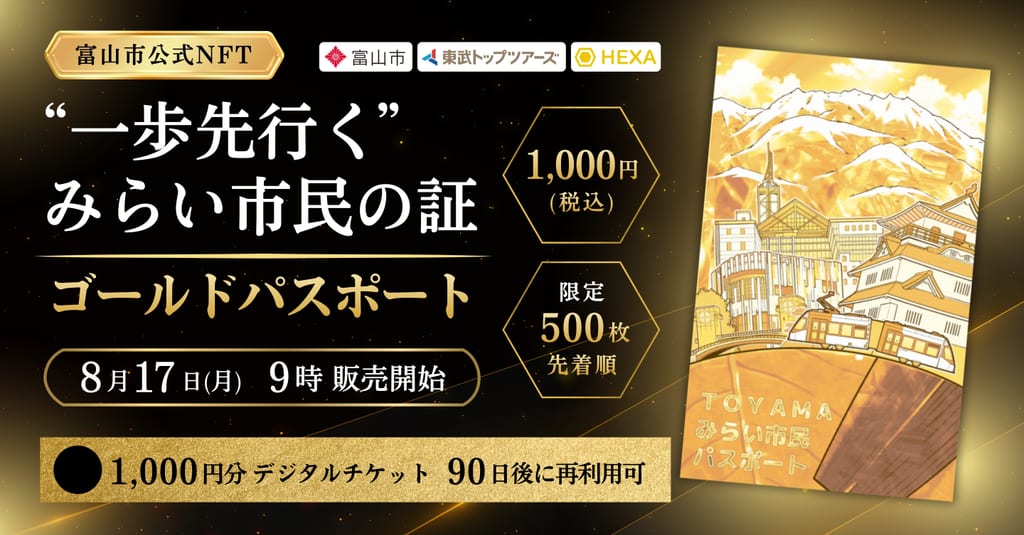
As a paid version of its free "TOYAMA Mirai Citizen Passport," Toyama City, in partnership with Tobu Top Tours Co., Ltd., began selling the TOYAMA Mirai Citizen Passport (Gold), "proof of being a TOYAMA Mirai citizen who is one step ahead," on August 17, 2026. The price is ¥1,000 (tax included), 500 passes are issued (first-come, first-served), and it is available to people living outside Toyama Prefecture.
Holders can take part in more in-depth projects in the exclusive community "TOYAMA Mirai Citizen Community Plus," and receive a digital ticket worth ¥1,000 usable at 3 shops around Toyama Station and Toyama Airport, which can be used again 90 days after use. A key feature is that it encourages repeat visits by making each visit worthwhile rather than ending with a single trip. It is an example of a staged design, in which the highly engaged among the related population gathered widely through free distribution are cultivated further with a paid membership.
Digital resident NFT in partnership with a manga artist's IP [Kumakogen Town, Ehime Prefecture]
Kumakogen Town, Ehime Prefecture, partnered with "Kamuiverse," a virtual space based on the world of manga artist Kamui Fujiwara's works, to sell an officially endorsed municipal digital resident NFT. The town is the first partner of "+α Kamuiverse Regional Revitalization," and the initiative grew out of sake brewing done together with Kamuiverse users.
Holders receive perks such as joining the LINE community "Kumakogen Town Digital Residents DAO," the Digi-min MAP, social events in the "Kumakogen" world inside the virtual space, and planning and taking part in "Kumakogen TV," which shares town news in a TV-show style. It is designed to use the IP's world as a gateway to building a region people can feel attached to as a second hometown.

A digital membership card offering lasting discounts on roadside station (michi-no-eki) experiences [Ogawa Town, Saitama Prefecture]
Ogawa Town, Saitama Prefecture, in partnership with Tobu Top Tours Co., Ltd., held a first-come, first-served sale of the Roadside Station Ogawamachi Digital Membership Card at ¥1,000 each, offering lasting discounts on experiences in the town (issued by the Ogawa Town Tourism Association). The card gives discounts on experiences in the town, starting with a 203m-long roller slide.
Anyone with a credit card and a smartphone can buy it, and NFTs' uniqueness means the membership cards circulate without copies or counterfeits. One person can buy multiple cards and resell them, and part of each resale price is paid to the issuer, so the secondary market itself becomes support for the town.

Digital resident NFT exhibited at the "Regional Revitalization SDGs Fes" at Expo 2025 Osaka, Kansai [Habikino City, Osaka Prefecture]
Habikino City, Osaka Prefecture, sold its second digital resident NFT at the EXPO 2025 Osaka, Kansai, Japan "Regional Revitalization SDGs Fes". The aim was to showcase the city's appeal to foreign tourists and domestic travelers at the Expo venue, and to create related population from outside the region with a digital resident NFT, the first issued in the Kinki region.
Perks include the right to join a history tour where you can climb the Minegatsuka Kofun, a component of the Mozu-Furuichi Kofun Group World Heritage site that is normally off-limits, with commentary from an expert, as well as an online meeting with the head of the city's Cultural Properties and World Heritage Office and others. It is an example of using a large-scale event like the Expo as a touchpoint for building related population.

For municipalities considering membership & ticket NFTs, click here
Municipal success stories with free NFT distribution
Many municipalities face the question of "how to increase related population and keep it going." As birth rates fall, populations age and decline, municipalities across Japan need regional development that does not rely solely on increasing the resident population. At the same time, there are many cases where tourism initiatives increase the number of visitors, but the relationship ends after a single visit.
In response to these challenges, a key theme is how to increase the "related population" (people who, while living outside the region, keep receiving information, sharing opinions, joining events and supporting the region) and grow these into long-term relationships.
The solution is a two-way community limited to NFT holders. People who obtain an NFT can
• continuously receive official information from the municipality (on relocation and U-turn migration, jobs, furusato nozei, events and more)
• take part in regional development through surveys and calls for opinions
• interact with others who share the same interest
and in these ways join a space where they connect two-way with the region and with other members of the related population. Because holding an NFT is the condition for joining the community, another major feature is that it tends to form a high-quality community made up not of an unspecified crowd, but only of people who want to stay involved with the region.
This mechanism creates a flow in which, rather than ending once an NFT is obtained or handed out, relationships deepen through continued participation, and as a result the related population grows.
Specifically, free NFT giveaways work well for a wide range of promotional purposes, such as giving away NFTs in social media campaigns, distributing NFTs through stamp rallies, or printing QR codes on product packaging to hand out NFTs.
Flooded with applications from outside the prefecture: the TOYAMA Mirai Citizen Passport [Toyama City, Toyama Prefecture]
At the core of the passport is an interactive community for NFT holders only, provided on HEXA. People who obtain the passport can:
- Continuously receive official information from Toyama City (on relocation, U-turn moves back home, jobs, furusato nozei, events and more)
• take part in regional development through surveys and calls for opinions
- Connect with other people who share an interest in Toyama City
and in these ways join a space where they connect two-way with the region and with other members of the related population. Because holding an NFT is the condition for joining the community, another major feature is that it tends to form a high-quality community made up not of an unspecified crowd, but only of people who want to stay involved with the region.
This mechanism creates a flow in which, rather than ending once an NFT is obtained or handed out, relationships deepen through continued participation, and as a result the related population grows.
The first round was limited to 1,000 passports, and the city ran focused X ads aimed at the age groups and regions it wanted to reach.

As a result, applications came in at about 2.4 times the planned number, and in the survey taken at sign-up, 58% of all respondents said they were "seriously considering" or "somewhat considering" moving to the city.
Applicant profile
41% of applicants were in their 20s and 34% in their 30s (74% in their 20s–30s in total)
On moving to Toyama City in the future
"Seriously considering" and "somewhat considering": 58% combined
Experience living in or visiting Toyama City
"Have lived there": 25%
"Have visited 10 or more times": 22%
"Have visited a few times": 42%
(89% in total have lived in or visited the city)

Free trading card NFTs for users joining social media campaigns and in-person events [Nishikawa Town, Yamagata Prefecture]
Nishikawa Town, Yamagata Prefecture, gives away trading card NFTs free of charge to everyone who takes part in its in-person community events or social media campaigns. In a town of about 5,000 people, this grew its follower count from 527 to 1,214, a 2.3-fold increase (687 more). It has also succeeded in drawing many fans from outside the town to its in-person events.


Five municipalities in a Cabinet Office model project give away regional NFTs free and involve holders in product development through a DAO [Yachiyo Town, Ibaraki Prefecture; Noda City, Chiba Prefecture; Katsuragi City, Nara Prefecture; Hakui City, Ishikawa Prefecture; Takahama Town, Fukui Prefecture]
In a regional revitalization model project run by the Public-Private Partnership Promotion Organization (a general incorporated association) using the Cabinet Office's "Regional Future Grant," the regional NFTs of the five participating municipalities, the "New Product Development Project Pass," were given away free of charge (the lead municipality is Yachiyo Town, Ibaraki Prefecture, and the project is carried out by GMTS Co., Ltd.).
The NFT serves as a "participation pass" for taking part in community building. Holders can join an owner-only DAO community where they propose "ideas" and take part in "design votes" for collaboration products made by local businesses and idols, and help out at or join each region's events and sales events. Because the NFT can be received with just an email address, with no crypto or wallet needed, local residents unfamiliar with digital tools and fans across Japan can take part without costs or complicated procedures. The same model project also sells a paid version created in collaboration with artists (details of the paid version).

For municipalities considering free giveaways to build a related population, click here
Municipal success stories with certificate NFTs
Attaching NFT certification lets you number items that could otherwise be copied endlessly, giving them scarcity. An NFT certificate makes duplication and forgery difficult, so that scarcity can be turned into value. This repositions economic value at global prices in a form where copies and fakes cannot circulate, in line with the policy set out in the government's "Regional Revitalization 2.0" for protecting the regions: "use blockchain technology and NFTs to reprice the diverse analog value held by regions, such as food and tourism experiences, at global prices and maximize it."
At the Kyushu Grand Sumo Tournament, goshuin (shrine seal stamps) with NFT certification sold as assets to inbound visitors at 20 times the usual price [Fukuoka City, Fukuoka Prefecture]
As part of the Japan Tourism Agency's "Project to Expand and Improve Inbound Consumption through Special Experiences," asset-grade goshuin went on sale at Fukuoka City's booth at the Kyushu Grand Sumo Tournament. These limited-quantity goshuin, issued by Torikai Hachimangu Shrine, carry NFT certification guaranteeing their uniqueness, a first in Japan.

Torikai Hachimangu Shrine issues the goshuin in 3 colors (50 of each), for a total of only 150. Each goshuin is numbered, and only 150 exist in the world. On their own, goshuin risk being copied or forged, but every one of the 150 carries NFT certification using blockchain technology, which prevents copying and forgery. Even if a goshuin itself is copied or forged, the NFT that serves as its certificate cannot be copied or duplicated, so transferring or trading the goshuin together with its certificate NFT makes it possible to prevent forgery.

This gives asset value to goshuin, for which managing the number issued and proving authenticity had been difficult, and they are sold mainly to inbound foreign tourists visiting Japan for the Kyushu Grand Sumo Tournament. A regular goshuin sells for ¥1,500, while the limited-quantity asset-grade goshuin with NFT certification sell for ¥10,000–¥30,000, up to 20 times the price.
For municipalities considering NFT certificates, click here
Municipal success stories with naming rights NFTs
Many municipalities sell naming rights to parks, pedestrian bridges and streets, but in areas that are little known or have small populations, naming rights often receive not a single bid. Selling them as naming rights NFTs instead can draw many individuals and companies to take part, growing the town's related population and fan base and energizing the region.
Naming rights to a park in a town of about 5,000 people won at ¥1.3 million
In the park naming rights NFT auction held by Nishikawa Town, Yamagata Prefecture, there were 14 bids on the first day, raising the price to ¥101,000, and the auction closed on the last day with a bid of ¥1,300,000.

Naming rights NFT for a new canoe center won at ¥1.5 million
Nishikawa Town, Yamagata Prefecture, turned the naming rights to the canoe center it is opening in June 2025 into an NFT and sold it at auction. The canoe center naming rights NFT received 21 bids in total and was won at ¥1.5 million.
The name chosen through the naming rights NFT will be put up on a sign, along with a QR code linking to the naming rights NFT. This proves who holds the naming rights NFT, so even if the NFT is transferred or resold, the holder can be identified and verified.

For municipalities considering naming rights NFTs, click here
Furusato nozei (hometown tax donation) NFTs & support NFTs
NFTs are sold as furusato nozei return gifts or to raise support. The key is to make clear how the funds raised from NFT sales will be used, and to design the NFT as proof of that support.
An NFT to secure operating and maintenance costs: the JR Tadami Line En-musubi (Matchmaking) NFT [Tadami Town, Fukushima Prefecture]
The JR Tadami Line, which fully reopened on October 1, 2022, costs about ¥300 million a year to operate, borne by Fukushima Prefecture and 17 municipalities in the Aizu region. Part of the sales proceeds goes toward the line's operating and maintenance costs. Holders of the "JR Tadami Line En-musubi NFT" also receive perks at shops in the town.

Ticket NFTs of a local mascot as furusato nozei return gifts [Fukaya City, Saitama Prefecture]
Fukaya City, Saitama Prefecture, sold the Fukka-chan NFT, the first NFT of the city's official character Fukka-chan, as a furusato nozei return gift. It consisted of 50 for general sale (¥3,000 each, tax included) and 50 as furusato nozei return gifts (¥10,000 each).
Rather than just a digital picture, it is a ticket NFT that can be exchanged at the roadside station (michi-no-eki) Okabe for either a set of Fukaya green onions (worth ¥1,000, tax included) or an assortment of Fukka-chan goods. Turning the ticket into an NFT allows resale on the secondary market without fakes circulating, and the connection with the holder remains even after the return gift has been used.

For municipalities considering furusato nozei or support NFTs, click here
NFTs by Yuichiro Tamaki, leader of the Democratic Party for the People
Yuichiro Tamaki, leader of the Democratic Party for the People, has issued tradable NFTs, the first NFTs ever issued by the leader of a political party. He also explained NFTs on his own YouTube channel, "Tamaki Channel."

Municipal NFT × DAO cases
Some municipalities have also built a DAO (Decentralized Autonomous Organization) whose members are NFT holders, energizing how their community is run.
A DAO, or "decentralized autonomous organization," is a new kind of organization or community run using blockchain technology. Buying an NFT, that is, "holding a token," makes you an official member of that DAO.
In Nishikawa Town, Yamagata Prefecture, digital residents (people who hold a digital resident NFT) actually vote to decide the rarity levels of the digital trading card designs that promote the town's attractions.

NFTs as a low-cost way for municipalities to attract visitors
The Unlimited Fruit Ticket NFT (¥1,000 per person) and the Nishikawa Town Free Hot Spring NFT (¥350 per person) attract visitors from outside the town at a far lower cost than other city promotion measures. Digital NFT perks combine buzz, continuity and repeat visits, making them more cost-effective than conventional measures.
| Measure | Perk | Cost to attract 1 visitor from outside the town | Features | Compared with other measures |
| Unlimited Fruit Ticket NFT | Seasonal fruit | About ¥1,000 | Holders can enjoy local produce on an ongoing basis. Generates buzz and easily turns people into fans | 1/2–1/10 the cost of typical tourism measures |
| Nishikawa Town Free Hot Spring Digital Resident NFT | Free bathing at hot springs in the town | About ¥350 | Directly creates a reason to visit the town and can be expected to turn visitors into repeat visitors | 1/5–1/20 the cost of typical tourism measures |
| TV commercials and transit ads | Raising awareness | Several thousand yen to ¥10,000 or more | Can build awareness on a large scale, but cost-effectiveness is relatively low | Several times to more than 10 times the cost of NFT measures |
| Distributing tourist brochures | Advertising through print media | Several thousand yen or more | Provides information but rarely leads directly to visits | Several times the cost of NFT measures |
| Holding events (festivals, fireworks displays, etc.) | On-site experience | ¥2,000–¥5,000 or more | Brings many people at once, but the lasting effect is weak | 2–10 times the cost of NFT measures |
| Social media and web ads | Driving ad clicks | About ¥2,000–¥10,000 (per visit) | Allows targeting, but the lasting effect is weak | Several times to more than ten times the cost of NFT measures |
Regional revitalization NFT issuance support for municipalities
HEXA offers a range of NFT issuance support for municipalities. You can simply register an account on HEXA from the web and use it as is, and we also take inquiries about everything from planning an NFT to operational support. Please feel free to contact us.