
What is an NFT?
An NFT (non-fungible token) is digital data that has been proven on a blockchain to be "the one and only genuine original in the world." It is a technology that gives copyable digital works a record of ownership and uniqueness, and it is used for art, music, memberships, tickets, certificates and more.
NFT stands for Non-Fungible Token and is often described in Japanese as a "digital asset." Before NFTs appeared, it was hard to see digital works as having asset value, because copies identical to the original could be made easily and endlessly. In recent years, however, the arrival of blockchain technology has changed this completely. By issuing an NFT, it has become possible to give a digital work value as a "one-of-a-kind" item. NFTs, which have overturned the conventional wisdom about digital content, are now attracting a great deal of attention.
Contents
- What is an NFT?
- Features of NFTs
- NFTs as an idea and culture: "data has value"
- Using NFT technology for memberships and tickets
- NFTs have asset value and are easier to handle than physical goods
- More about NFTs
- How NFTs work
- NFT standards
- What can be issued as an NFT
- The legal treatment of NFTs
- Advantages and disadvantages of NFTs
- How to issue NFTs, and NFT marketplaces
- Comparing NFT marketplaces (C2C or B2C, yen or crypto)
- Comparing NFT marketplaces 2 (chains, withdrawals)
- How to sell NFTs
- How to buy NFTs
- Tax filing and accounting for NFTs
- The future of NFTs
What is an NFT, in simple terms?
In a nutshell, it is a mechanism that attaches to digital data "a certificate bearing the owner's name that cannot be rewritten." The picture or photo itself can still be copied as before, but the record of "who the genuine owner is" cannot be copied. This record is kept on a blockchain — a ledger shared by computers around the world that cannot be rewritten after the fact.
To compare it to something in the real world, it is close to a certificate of authenticity for a work of art, or a membership card bearing your name. You can print as many posters of the same image as you like, but there is only one proof that a given copy is "the one the artist authorized."
How NFTs differ from Bitcoin (cryptocurrency)
They use the same blockchain technology, but the decisive difference is whether they are interchangeable. With Bitcoin, 1 BTC has the same value no matter who holds it, so swapping one for another makes no difference (it is fungible). Each NFT, on the other hand, is distinct, and swapping one for another changes its meaning (it is non-fungible).
| | Cryptocurrencies such as Bitcoin | NFT |
|---|---|---|
| Interchangeable | Yes (every 1 BTC is the same) | No (each one is distinct) |
| Main uses | Remittances, payments, investment | Works, memberships, tickets, certificates |
| Unit | Divisible, e.g. 0.01 BTC | Whole units only (not divided) |
| How prices are set | A single market price set by supply and demand | Each item has its own price |
| Legal treatment | Crypto-assets under the Payment Services Act | Generally not crypto-assets (depends on design) |
People often assume that "you need cryptocurrency to buy NFTs," but this isn't true either. There are marketplaces such as HEXA where you can buy with just a credit card payment in Japanese yen, with no crypto or wallet required.
Features of NFTs
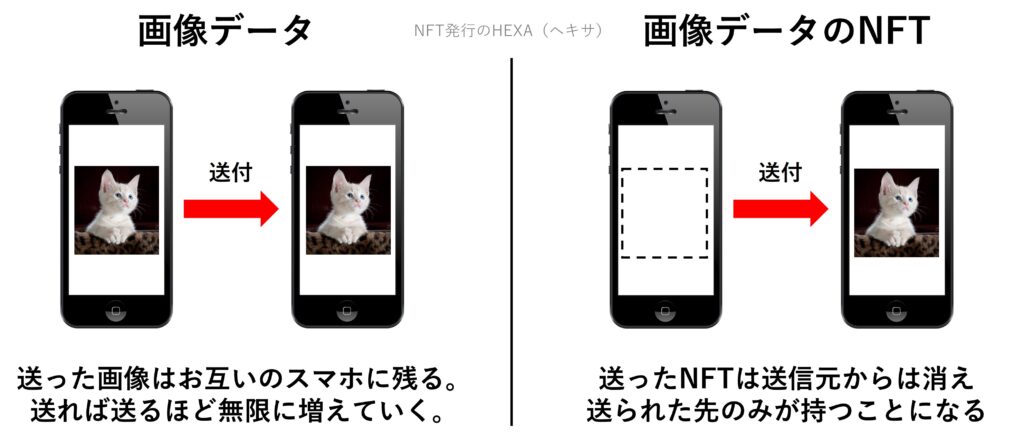
The above is a conceptual analogy for understanding NFTs. When you send image data by email or similar means, the image data is duplicated, and copies remain with both the sender and the recipient. In a world without NFTs, data was copied endlessly. With an NFT, however, when you send it to someone, the sender no longer has ownership. The data itself does not disappear; rather, ownership of the NFT transfers to the recipient. This technology has made it possible to do on the internet the same thing we have always done with one-of-a-kind items in the real world.
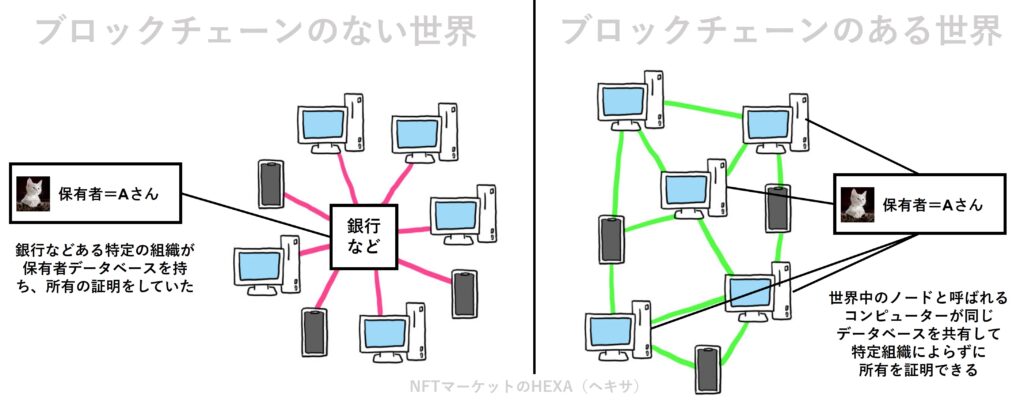
The diagram above also illustrates the technical concept of NFTs: blockchain technology is the mechanism used to give digital data an owner. Previously, proving ownership of digital data required a centralized institution such as a bank. Before blockchain, that institution kept a ledger recording who held which data, and that is how ownership was established. With the arrival of blockchain technology, however, computers around the world called nodes all hold the same database (a distributed ledger) without relying on any such centralized organization, which makes it possible to identify a single owner of the data.
NFTs as an idea and culture: "data has value"
The most important thing about NFTs is that the idea that "data has value" spreads widely among the general public. This has important implications for service development. As a result, the idea that one-of-a-kind items can be exchanged in the digital world takes root, and economic activity that has so far been based on the premise that physical things have value will also take place digitally.
NFT consumption to satisfy the desire to invest
In the real world, people have long bought actual works of art as investments. As the idea that data has value spreads, a similar economic activity of investing in art NFTs is beginning to emerge.
NFT consumption to satisfy the desire to collect
Economic activity driven by the desire to collect — buying clothes with designs that catch your eye, buying and collecting stamps, and so on — is beginning to emerge in the world of NFTs as well: buying NFTs with designs you like, collecting 3D works that move you, and so on.
NFT consumption to satisfy the desire for recognition and to contribute
Behaviors seen in the real world — buying lots of merchandise to support a favorite idol or character, or going to the cinema 10 times to make Rengoku a "¥30 billion man" (a reference to the box-office record of the anime film Demon Slayer: Mugen Train) — are beginning to appear in the world of NFTs too. What's more, in the world of NFTs, your contribution remains as a digital record, which your favorite idol can recognize. And for fans who supported an idol from the early days, if the idol becomes famous later, rising demand for the NFT and the resulting price increase may even pay them back.
Using NFT technology for memberships and tickets
Using the technology NFTs provide for representing ownership of data, memberships and tickets that used to take the form of paper or plastic cards are increasingly being turned into digital memberships and tickets. Without having to build your own membership or ticketing system, you can use the blockchain to issue cutting-edge digital memberships and tickets that incorporate NFT technology — such as protection against counterfeiting and guaranteed uniqueness — with no maintenance costs. For details on membership & ticket NFTs, see here.
NFTs have asset value and are easier to handle than physical goods
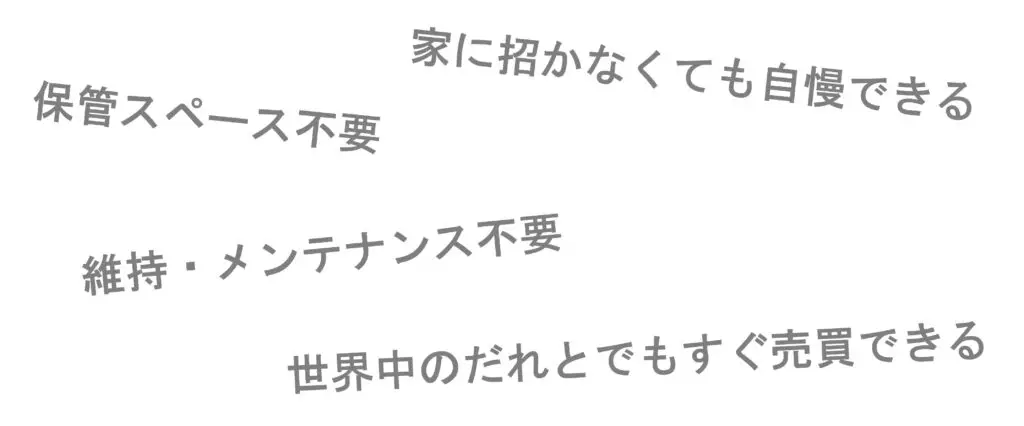
NFTs are a technology that lets digital data be traded in the same way as one-of-a-kind works of art in the real world. Compared with physical assets such as artworks, they require no storage space and no upkeep or maintenance. Paintings and vintage wine need not only storage space but also careful temperature and humidity control, so simply owning and maintaining them keeps costing money. NFTs, by contrast, are stored on the blockchain as digital data that does not deteriorate, so no storage space or maintenance is needed. You can also buy and sell them with anyone in the world at any time, and you can instantly show people around the world which NFTs you own, so there's no need to invite people to your home to show them off as you might with artwork. In this way, NFTs are far more convenient than physical assets and offer major advantages as assets.
More about NFTs
NFT stands for Non-Fungible Token; it is essentially a "certificate" of the right to hold a piece of digital data. In Japanese it is translated as "hidaitaisei token" or "daitai fukano na token" (non-substitutable token). "Token" is a word that is hard to pin down, with meanings such as "sign," "proof" and "substitute currency," but here think of it as something like "a certificate of ownership guaranteed by the blockchain."
Being fungible means something can be exchanged for something else of the same value — money is a typical example. Normally, there's no problem at all with swapping your ¥100 coin for a friend's ¥100 coin.
But what if it were a ¥100 coin that a certain idol had held in her hand? To a devoted fan of that idol, that ¥100 coin could no longer be exchanged for any other ¥100 coin — it would be a unique, non-fungible item.
Signed books are also non-fungible. No matter how many tens of thousands of copies of the same book are in bookstores across the country, a copy signed by the author cannot be swapped for any other.
In the same way, when digital content — of which infinite copies can exist — is turned into an NFT, it becomes a unique, non-fungible item.
Issuing an NFT gives digital content the concept of "ownership," making it possible to give it uniqueness in that only the NFT holder is recognized as having the right to own the data. NFTs created asset value for digital data. And anyone can issue an NFT easily.
How NFTs work
How does issuing an NFT guarantee the right to hold digital content and make it one of a kind?
Issuing an NFT means recording who holds ownership on the blockchain. NFTs rely on blockchain technology, which makes tampering with data practically impossible.
How blockchain works
A blockchain is a ledger that records electronic transactions.
All transactions made on the network are recorded at regular intervals in batches called "blocks," and each block is linked to the block created just before it. Because blocks are linked one after another in this way, it is called a blockchain.
Blockchains have mechanisms that prevent tampering almost 100% of the time.
One of these is the "hash value." A block stores not only transaction details but also a hash value derived from the data in the previous block. So if someone tries to forge data in a past block, the hash values of all the blocks linked to it will change; to succeed, the forger would have to tamper with the hash values of every subsequent block as well. This is practically impossible. Moreover, hash values are produced by a one-way function called a "hash function," so it is extremely difficult to derive the original data from a hash value.
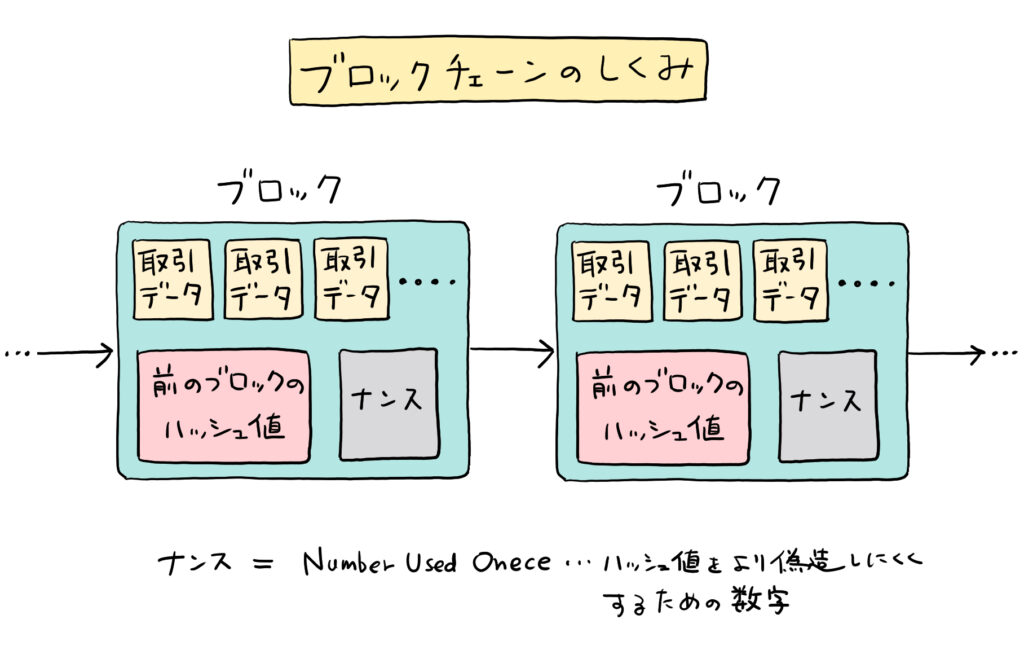
Economic transactions have traditionally been centralized, managed by institutions such as banks. A blockchain, in contrast, uses an entirely new decentralized model with no administrator, managed jointly by everyone participating in the network. Because anyone on the network can share and verify transaction data, fraud is unlikely to occur.
When data is recorded on a blockchain, it must always be "digitally signed" and encrypted. The digital signature is made with a "private key" held by the creator of the data. The private key must be kept strictly secure so that it never leaks, but the "public key" generated from the private key is, as the name suggests, public, and anyone on the network can use it to verify the authenticity of the data. In other words, by decrypting data encrypted with the private key using the public key, you can verify that the data was definitely created by its creator.
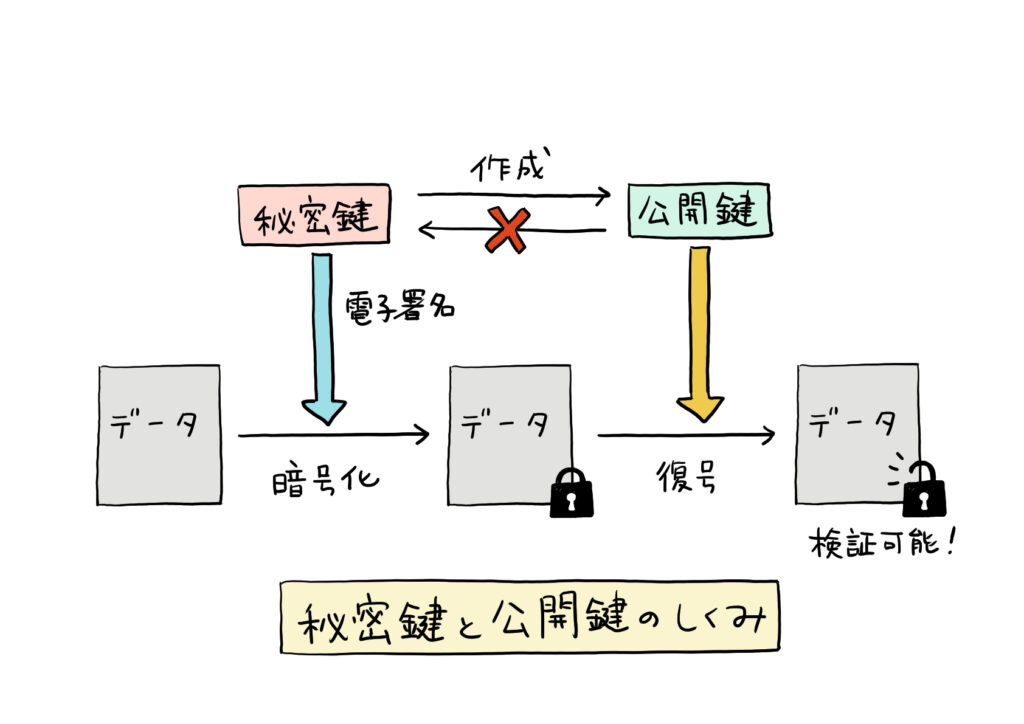
These mechanisms guarantee the authenticity of ownership of digital content issued as an NFT.
Blockchains that can be used for NFTs
Blockchains that can be used for NFTs include Ethereum, where most NFT trading currently takes place, as well as Binance Smart Chain, Flow, Tron, EOS, Polkadot, Tezos, Cosmos, WAX and others, and as NFTs grow in popularity, new entrants keep appearing.
In Japan, LINE NFT and Rakuten NFT have entered the NFT marketplace business on the basis of blockchains they developed in-house.
NFT standards
How an NFT is linked to its content is determined by its standard.
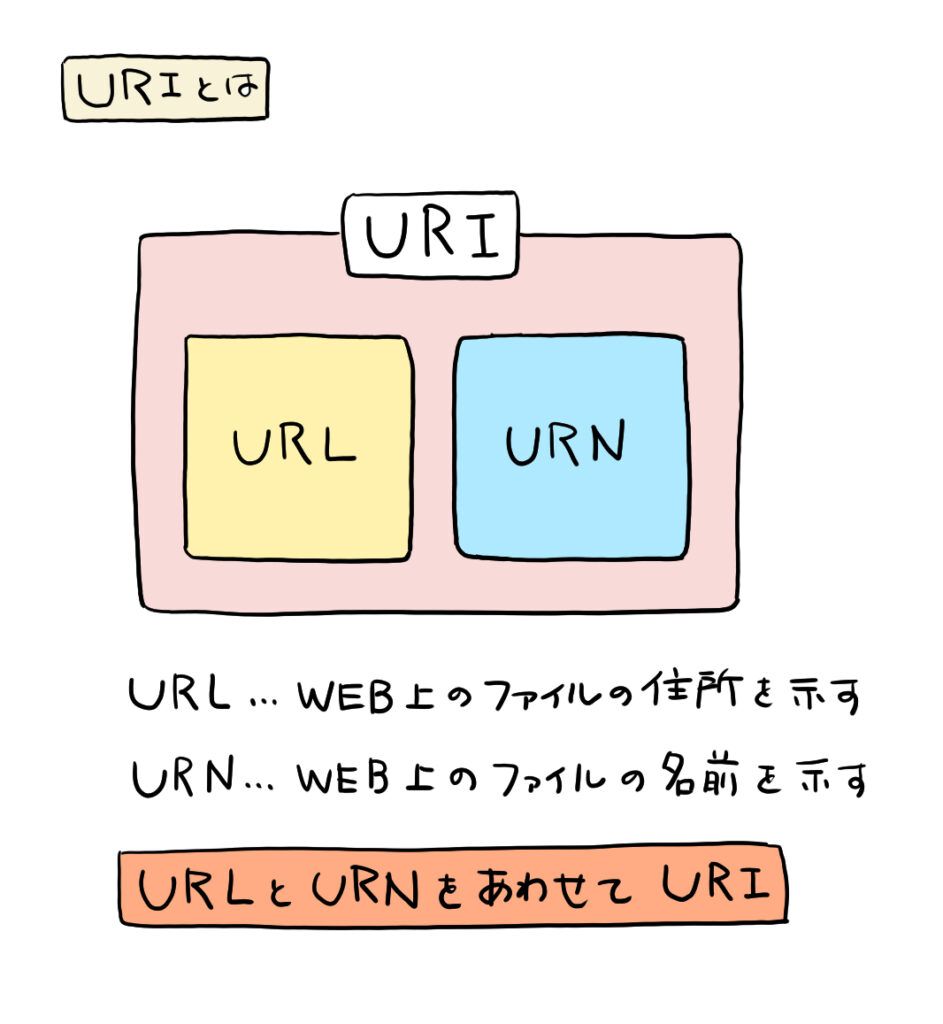
Of Ethereum's 9 token standards, 2 are NFT standards: ERC721 and ERC1155. Tokens created with these standards are linked to a token ID and a URI (Uniform Resource Identifier) that indicates where the content is stored. URI may be an unfamiliar term, but it is an identifier for any file on the web, and a broader term than URL, which indicates the address of a file on the web.
A URI can include metadata such as the data's creation date, creator and owner.
Because this information is written to a blockchain that cannot be tampered with, the unique value of the digital content is guaranteed.
What can be issued as an NFT
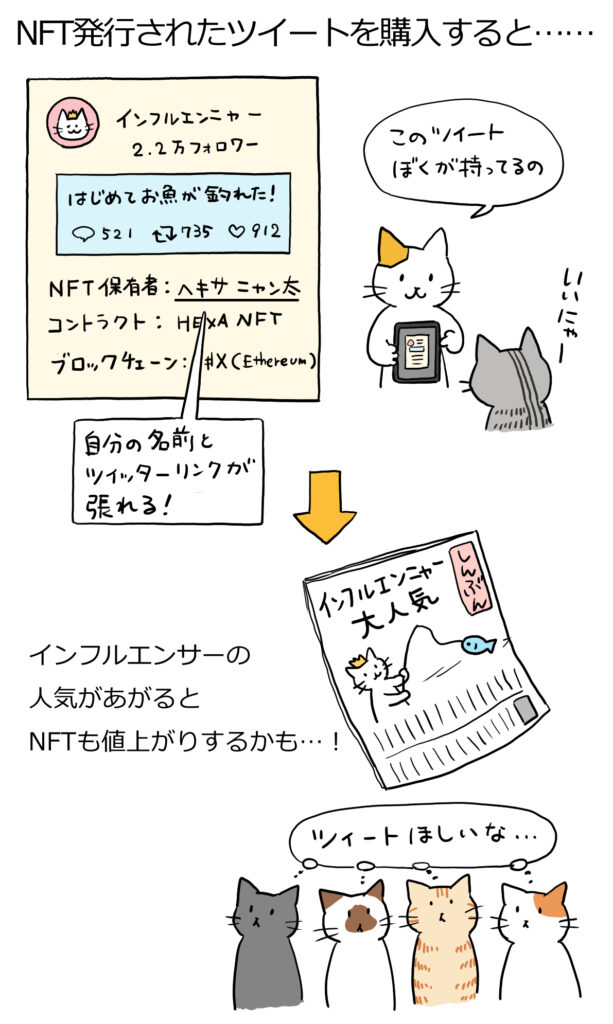
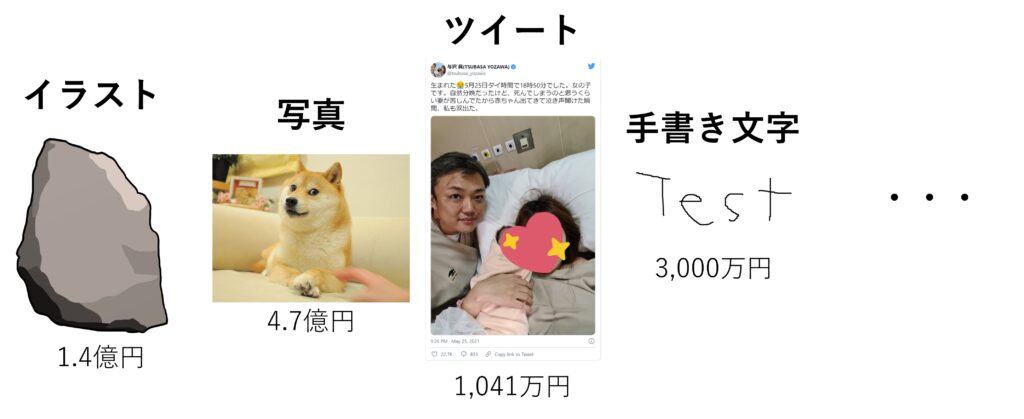
You may well remember the news: the first tweet by Jack Dorsey, CEO of Twitter (now X), "just setting up my twttr," which he turned into an NFT, sold at auction for about ¥300 million; in Japan, Tsubasa Yozawa's tweet NFT about the birth of his second child sold on HEXA for about ¥10.41 million; and "Everydays ― The First 5000 Days," an NFT collage of digital art by Michael Winkelmann, the artist known online as Beeple, sold for about ¥7.5 billion.
Beyond tweets and digital art, all kinds of digital content are being turned into NFTs.
Trading card NFTs are popular with collectors. NBA Top Shot, which turns highlight videos from NBA games into digital cards, has soared, and cards of star players in particular trade at high prices. In Japan, "Ikinari NFT Trading Cards" featuring live photos of the idol group SKE48 were released, and the limited packs sold out immediately.
Game items and characters are also being turned into NFTs. Gems that until now had value only inside a game might gain real-world value by becoming NFTs, and a weapon a famous player used to defeat a monster might trade at a high price. It's also possible for a character from one game to break out of that game and appear in another.
Virtual land in blockchain games has fetched over ¥100 million, virtual fashion items have been released — all kinds of digital content are being issued as NFTs.
Not only digital content but also real assets and items can be linked to NFTs. Nike has obtained a patent for turning sneakers into NFTs on the Ethereum blockchain.
Popular sneakers have recently been trading at high prices, so turning sneakers into NFTs aims to prove that they were sold through official channels and are not counterfeit. Nike is also considering turning sneaker designs into NFTs that can be used as items in blockchain games.
As you can see, there is virtually no limit to what can be issued as an NFT — it all depends on your ideas. If you'd like to learn more about NFT issuance examples in Japan, see here.
The legal treatment of NFTs
At present, a proper legal framework for NFTs has not yet been put in place.
Crypto-assets such as Bitcoin were defined in the amended Payment Services Act, which took effect in April 2017. NFTs, though likewise tokens on a blockchain, are interpreted as not being crypto-assets because, among other reasons, they cannot be used as a means of payment. Accordingly, NFT transactions are currently considered not to be subject to regulations such as the Financial Instruments and Exchange Act.
Digital content is intangible. Under Japan's Civil Code, a "thing" means a tangible object such as movable property or real estate, so digital content cannot be the subject of ownership rights. "Holding" an NFT is a vague expression, but it can be understood as a legal position based on a contractual relationship.
In addition, unless a separate special contract is concluded, the copyright does not transfer to the buyer but remains with the creator. For this reason, an NFT buyer cannot copy or sell the content. Even after the NFT passes into the buyer's hands, the creator can freely use the content. Turning a tweet into an NFT and selling it does not remove the tweet from the account.
Be careful about whether an NFT counts as a security
When issuing NFTs, you need to take care that they do not qualify as interests in a collective investment scheme. It is difficult to attach rights such as receiving profit dividends or distributions of assets from the business being invested in.
Be careful about whether an NFT counts as a crypto-asset
When many NFTs that look identical are issued, you need to be careful about whether they qualify as crypto-assets. Being an NFT (ERC721) does not automatically mean it is not a crypto-asset.
Check whether an NFT might conflict with the Payment Services Act
When considering utility, the NFT must be designed so that it does not qualify as a prepaid payment instrument or a funds transfer (exchange transaction).
Check whether NFT sales might conflict with the Act against Unjustifiable Premiums and Misleading Representations
When considering utility, you need to carefully consider how the Act against Unjustifiable Premiums and Misleading Representations applies, taking the secondary market into account.
Advantages and disadvantages of NFTs
Advantages of NFTs
The biggest advantage of NFTs is probably that they give digital content uniqueness. Until now, giving value to easily copied digital content meant paying for copy prevention such as copy guards and digital watermarks, and the digital content itself was not worth much.
Turning it into an NFT makes digital content one of a kind and makes it possible to create high value. Another advantage is that blockchain technology makes digital content issued as NFTs extremely difficult to counterfeit or steal.
In NFT transactions, smart contracts execute contracts automatically, so no intermediaries are needed and costs can be kept down. It is also possible to let creators receive royalties every time a work is bought and sold, which boosts creators' motivation and helps sustain their creative activity. NFTs on the same blockchain can be traded across platforms. This has made it possible, for example, to bring items from one game into another game.
Disadvantages of NFTs
One current problem with NFTs is that it is difficult to verify the identity of NFT issuers. There have been actual cases of people downloading others' works published online without permission and issuing NFTs while impersonating the creator. HEXA has, for example, addressed this problem by verifying issuers through their X (formerly Twitter) accounts.
Even if you hold an NFT, the content it is linked to may lose its value. For example, if you buy an NFT of a game item and the game's service then ends, you may no longer be able to use the item.
Also, if you lose the private key for an NFT, you will no longer be able to access it. Private keys cannot be reissued, so be careful.
How to issue NFTs, and NFT marketplaces
Issuing an NFT generally starts with choosing an NFT marketplace. An NFT marketplace is a service with features for turning digital data into NFTs (digital assets) and selling them, as well as buying, holding and reselling them. There are many NFT marketplaces, led by the world's largest, OpenSea (which requires crypto and a wallet), and HEXA, one of Japan's largest, which requires no crypto or wallet. Here we introduce these NFT marketplaces by category. If you only want to see the comparison of NFT marketplaces, see here.
Comparing NFT marketplaces (C2C or B2C, yen or crypto)
One way to categorize NFT marketplaces is along two axes: whether they are C2C or B2C, and whether payment is in yen or in crypto. Categorized along these axes, they look like this.
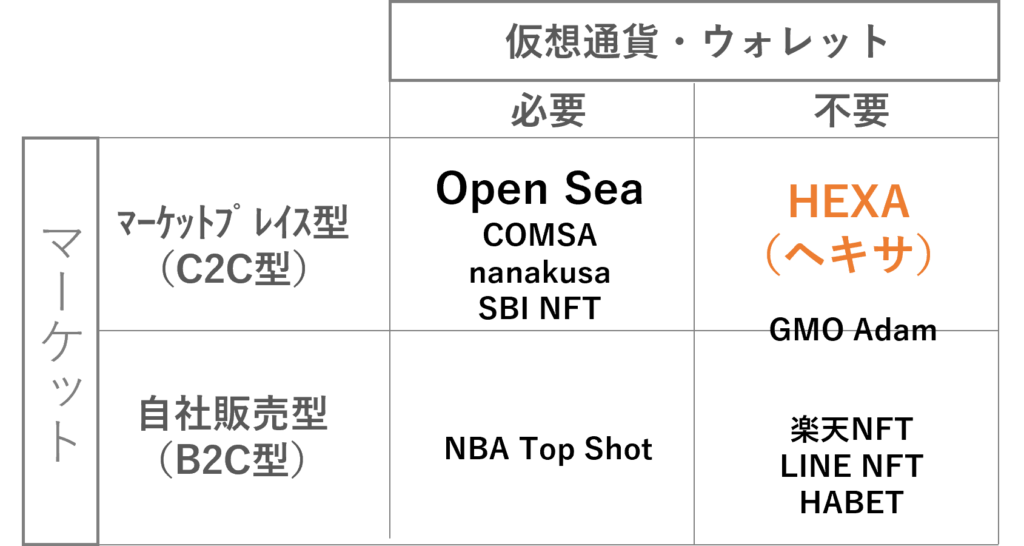
C2C (marketplace) or B2C (direct sales)
The first axis is whether a service is a marketplace (C2C) or a direct-sales platform (B2C). On a marketplace, anyone can freely carry out a primary sale of NFTs (turning digital data they created into an NFT and selling it).
On OpenSea, one of the world's largest, anyone with a wallet and gas fees (in crypto) can issue and sell NFTs as a primary sale. On HEXA, one of Japan's largest, anyone with an X (formerly Twitter) account can issue and sell NFTs as a primary sale at no cost.
COMSA on Symbol (XYM) also allows purchases paid in Japanese yen, but it requires a Symbol wallet; it is a marketplace where anyone can issue NFTs. nanakusa and SBI NFT are also marketplaces with the same functions as OpenSea, where anyone with a wallet and crypto can issue NFTs.
On the other hand, NBA Top Shot overseas lets you buy NFTs of content provided by the platform, but members of the public cannot issue their own. Rakuten NFT and LINE NFT are likewise direct-sales (B2C) marketplaces where the platform sells well-known content. Even on direct-sales platforms, however, you can resell the NFTs you buy on the secondary market. GMO Adam does not let just anyone issue NFTs, but issuers can apply in advance and issue NFTs after passing a review, so we have placed it on the borderline.
Whether crypto or a wallet is required
The next axis is whether a marketplace requires crypto such as ETH, MATIC or XYM, or a wallet such as MetaMask or a Symbol XYM wallet, to issue or buy NFTs. It is commonly said that only about 10,000 Japanese users hold NFTs in a wallet on OpenSea. Because you have to open an account with a crypto-asset exchange, buy crypto-assets, send them to MetaMask or a Symbol wallet, and then connect to the site from there, the barrier is still considered high for most ordinary users.
As a result, even when companies that own IP content or influencers with fans wanted to issue NFTs to build connections with their fans, most of those fans had no crypto or wallet, which made issuing NFTs difficult. HEXA, along with Rakuten NFT and LINE NFT, accepts credit card payments in Japanese yen and requires no wallet, so many influencers and companies have started issuing NFTs, and connections are beginning to form through NFTs with users who have no crypto or wallet.
Comparing NFT marketplaces 2 (chains, withdrawals)
Another way to categorize NFT marketplaces is by whether they use a public or private blockchain, and by how difficult it is to withdraw NFTs. Categorized along these axes, they look like this.
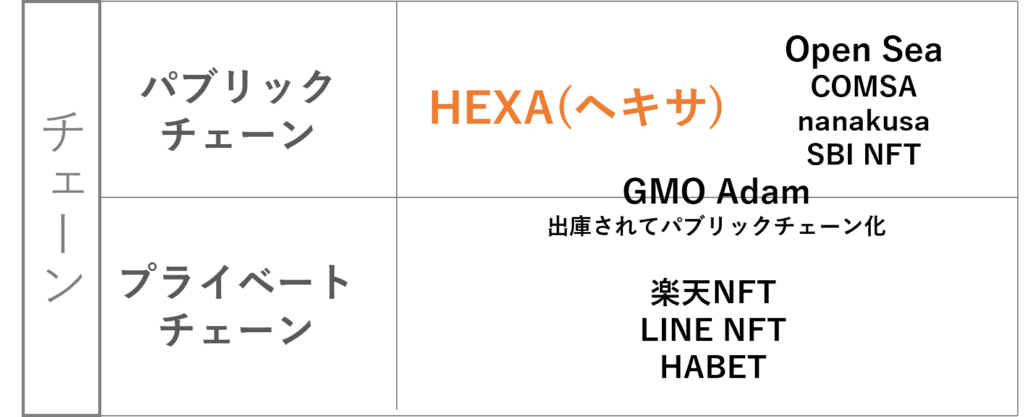
Public blockchain or private blockchain
The next axis is the type of blockchain on which the NFTs are issued. On a public blockchain (Ethereum, Polygon or Symbol), the NFTs themselves remain as long as the blockchain exists, even if the NFT marketplace shuts down. On a private blockchain, by contrast, the NFTs themselves disappear when the marketplace shuts down (although some services let you withdraw them to a public blockchain when they close).
Each type of blockchain has its advantages and disadvantages. NFTs gain value when everyone recognizes value in the digital data, so even on a private blockchain, an NFT can become valuable if people recognize its value. A private blockchain has the advantage of stronger governance (the operator can freely manage it afterward, so it can respond if a security problem occurs). Unlike a private blockchain, a public blockchain has the disadvantage that once an NFT is withdrawn, the service can no longer manage it, but some see that very fact as part of an NFT's value, so we recommend choosing after understanding the characteristics of each.
OpenSea, one of the world's largest, supports the Ethereum, Polygon and Solana chains, while HEXA, one of Japan's largest, is a public-chain NFT marketplace supporting the Ethereum and Polygon chains. As for GMO Adam, when a buyer pays a withdrawal fee of 0.05 ETH (a fee of ¥15,000, assuming 1 ETH = ¥300,000), the NFT is written to a public chain only upon withdrawal (until then it is on a private chain). For this reason, we have placed it midway between private chain and public chain. Only when the buyer pays the 0.05 ETH fee is it written to the private chain. Rakuten NFT, LINE NFT and HABET all handle NFTs on their own private chains.
How difficult it is to withdraw NFTs
Because HEXA does not require a wallet, when a user buys an NFT, the NFT has already been issued on a public blockchain but is held in custody in HEXA's wallet. Users can withdraw these NFTs to their own wallet at any time free of charge. If you send an NFT out and then deposit it back into HEXA, gas fees for the transfer are charged in crypto. OpenSea, nanakusa and SBI NFT work the same way as OpenSea: you cannot trade without a wallet and currency, and trades are made from each user's own wallet. As mentioned above, GMO Adam charges a fee of 0.05 ETH, roughly ¥15,000, when you withdraw an NFT.
The cost of issuing NFTs
Depending on the NFT issuance service, fees such as gas fees are charged when you issue an NFT. These are the costs incurred when a new NFT is created on the blockchain.
On HEXA, there is no fee just for issuing. This is because HEXA uses a method called lazy minting, in which the NFT is created on the blockchain only once it is actually sold (in some cases, HEXA takes on the risk and issues an NFT before it is sold). "Minting" means coining money, and issuing an NFT is referred to as "minting" it.
NFT issuance fees go up the more transactions there are on the network, so fees tend to be lower on weekends when there are fewer transactions.
On Ethereum-based platforms, where most NFT trading takes place, gas fees have soared, causing problems such as making it hard to profit from buying and selling NFTs and making it difficult for ordinary people to participate. In response, the rise of lower-fee blockchains such as Polygon, dubbed "Ethereum killers," is attracting attention.
How to sell NFTs
To sell an NFT, you need to turn the data you want to make into an NFT (images, videos, 3D data, music files, etc.) into an NFT using an NFT issuance service and then sell it.
Selling NFTs normally requires paying gas fees in crypto, which costs money. However, on HEXA, one of Japan's largest NFT marketplaces, you can issue an NFT in about 30 seconds with no upfront costs at all and no wallet or crypto required.
We recommend HEXA because many ordinary users who don't have crypto or a wallet can buy there.
You can issue on HEXA here.
Setting issuance conditions
When issuing an NFT, you can set the blockchain to issue it on (Ethereum, Polygon, etc.), the sales currency (Japanese yen, ETH, MATIC, XYM), the sale price, the sales method (auction, first-come, first-served, lottery), the royalty (a mechanism by which the issuer continues to receive a reward on secondary sales) and more, and then sell it.
Until now, when it came to buying and selling physical artworks, once a work left the creator's hands, the creator received none of the profit no matter how high a price it later sold for. By setting a royalty, however, the issuer can receive a reward every time the NFT is bought and sold, though only within the platform.
How to buy NFTs
Anyone can easily buy NFTs from a computer or smartphone. With HEXA, one of Japan's largest NFT marketplaces, you don't need crypto or a wallet and can buy right away by credit card.
To buy on OpenSea or similar platforms, you have to go through the hassle of opening an account at a crypto exchange that handles Ethereum, MATIC and so on, buying crypto-assets, installing a wallet app such as MetaMask on your smartphone or computer, sending the crypto-assets there from the exchange, and then connecting your wallet to OpenSea to make a purchase.
Can NFTs be converted to cash?
Yes. But only "if it sells." The way to turn an NFT into cash is to resell an NFT you hold and receive the proceeds. Just like real-world artwork or secondhand goods, it won't turn into cash unless someone buys it.
How you receive the money depends on the marketplace. On major overseas marketplaces, sales proceeds come in as crypto, so converting them to Japanese yen involves the hassle of cashing out on an exchange and the risk of price fluctuations. On marketplaces that support Japanese yen, proceeds are transferred directly to your bank account in Japanese yen, so you can cash out without ever touching crypto.
Note that if you make a profit from buying and selling NFTs, it is taxable. For how it is treated, see the section on tax filing and accounting for NFTs.
Tax filing and accounting for NFTs
If you buy NFTs with crypto, you will have to deal with crypto tax filing and accounting. Once you hold crypto, tax and accounting become a real burden. With HEXA, where transactions can be completed entirely in Japanese yen, no crypto accounting or tax processing is needed.
The future of NFTs
Some see the current overheated popularity of NFTs as a temporary bubble that will eventually burst. It's true that today's extreme excitement may not last long and may die down, but the problems NFTs face, such as those covered under disadvantages, are likely to be solved technically in time, and as a result trading should increase and prices stabilize. NFTs, which brought about a revolution by creating asset value for digital content, are expected to be used in many industries in the future.
For example, if more people use virtual spaces (the metaverse) as VR technology advances, people may buy and sell virtual land as NFTs, or wear NFT fashion items in virtual spaces while enjoying NFT art exhibitions.
Beyond digital content, NFTs can also be used for things that require proof of uniqueness, such as real estate ownership, memberships and identity documents. NFTs can also be used to build Web3-style relationships.
And because anyone can easily issue NFTs, you could say they hold the potential for individuals to achieve great success, depending on their ideas.
Frequently asked questions about NFTs
Q. What is an NFT, in simple terms?
A. It is digital data that has been proven on a blockchain to be "the one and only genuine original in the world." The digital work itself can be copied, but the record of "who the genuine owner is" cannot. It works much like a certificate of authenticity for a work of art.
Q. What is the difference between NFTs and Bitcoin?
A. The difference is whether they are interchangeable. Every 1 BTC has the same value and can be exchanged (it is fungible), but each NFT is distinct, and swapping one changes its meaning (it is non-fungible). Their uses also differ: Bitcoin is for remittances, payments and investment, while NFTs are for works, memberships, tickets and certificates.
Q. Can NFTs be converted to cash?
A. Yes. You resell an NFT you hold and receive the proceeds. However, it won't turn into cash unless someone buys it. On marketplaces that support Japanese yen, proceeds are transferred to your bank account in Japanese yen, so you can cash out without using crypto.
Q. Can you make money with NFTs?
A. There is no guarantee that an NFT will rise in value. NFT prices are determined by demand, so an NFT may not sell, or may fall in price. From the issuer's perspective, on the other hand, a marketplace that charges fees only when something sells lets you try selling without any out-of-pocket cost. Rather than for investment, NFTs are increasingly being used for practical purposes such as memberships, tickets and certificates.
Q. Do I need crypto to buy NFTs?
A. It depends on the marketplace. Major overseas marketplaces require crypto and a wallet, but on marketplaces that accept credit card payments in Japanese yen, you can buy without preparing any crypto or wallet.